


You are here:
Slip-Resistant Flooring (R9-R13) — Traction for Safe Work Areas
Quantec Industrieböden® GmbH installs slip-resistant flooring solutions (R9-R13) in existing industrial, logistics, parking garage, and commercial spaces—tailored to the specific use, level of soiling, cleaning requirements, and operational traffic patterns.

Slip resistance is beneficial when cleaning water, oils, or fine debris affect traction, thereby creating accident or process risks. The key is striking a balance between slip resistance and cleanability—a surface that is too rough can make cleaning and maintaining hygiene more difficult. Quantec selects the R-class as a system property within the coating structure and structurally integrates transitions and hotspots into the surface design.
Why Quantec?
Your Partner for Durable Industrial Floor Renovation
We don't see ourselves as merely a service provider, but as a reliable partner at your side. Every renovation project is planned carefully and precisely, carried out using high-quality materials, and designed for long-term use. This results in cost-effective and durable solutions for your industrial floor.

R-Class: Based on Practice, Not on Gut Feelings
Selection based on entry (wet/oily/dusty) and traffic logic.
Consider Ease of Cleaning
Traction and maintenance operations are planned jointly.
Secure Hotspots in a Targeted Manner
Prioritize ramps, gate areas, lanes, and crossings.
100% in-house work
Our own machinery—no subcontractors.
When a Lack of Traction Becomes an Operational Risk
In many facilities, slippery areas do not occur permanently but rather on a situational basis: cleaning processes, weather conditions, leaks, or product residue alter the surface. This leads to unsafe walkways, uncontrollable braking and steering behavior of forklifts, and increased risk on ramps or at gates.
Typical causes
Typical causes
- Moisture and cleaning water in walkways and work areas
- Oil/grease films in maintenance and machinery areas
- Fine dust or granules in logistics and packaging areas
- Recurring soiling in gate, ramp, and transition areas
- Mixed traffic areas (pedestrians + hand trucks + forklifts)

Slip resistance as a tailored surface property
Quantec designs slip-resistant surfaces to ensure that traction and ease of cleaning go hand in hand. The R-Class is achieved through system design and surface configuration, not as a “one-off measure.” Critical transitions are designed so that no new edges or points of failure are created.
Performance Ratings for Slip-Resistant Flooring (R9-R13)
Zoning by Risk and Land Use
- Division of the area into zones (walkways, workstations, traffic lanes, ramps)
- Determination of the slip-resistant finish for each zone
- Transition plan between different areas
Application as a coating system (EP/AC/PU depending on requirements)
- System design with a defined surface structure
- Resistance to abrasion, traffic, and cleaning chemicals
- Implementation in existing facilities with a predictable approval process
Preparatory work to ensure durability
- Spot Repair in Chipped and Edge Areas
- Crack repair when crack edges in traffic areas are critical
- Expansion joint repair when joint edges cause secondary damage
Which R-Class model makes sense—and where?
Slip resistance is increased where foot traffic and movement patterns require it. At the same time, the surface must remain suitable for cleaning and everyday use.
R9-R10
Typical areas with moderate risk and good cleanability
R11
Increased demands for regular entry or in critical work zones
R12-R13
High-traffic risk areas where traction takes priority over ease of cleaning
Divide the floor into zones with different slip resistance levels instead of making the entire surface “equally rough”
In practice, it is rarely necessary to make the entire surface slip-resistant. It is more effective to divide the area into zones: critical areas are given the appropriate surface texture, while standard areas remain easy to clean.
Key Elements of Implementation
Key Elements of Implementation
- Prioritizing ramps, gate areas, transitions, and walkways
- Defined transitions between zones to ensure safe use
- Implementation in sections to ensure that traffic routes remain open
- Reopening by zone and usage level

Typical Areas for Slip-Resistant Flooring
Doorways subject to weather and dirt
Ramps and crossings with slopes or thresholds
Cleaning and Washing Areas (Wet)
Maintenance Zones with Oil/Fuel Contamination
Walking Distances in Production, Assembly, and Order Fulfillment
Slip-Resistant Flooring (R9-R13) — Suitable for High-Traffic Areas and Easy Cleaning
Please send us the area of use, the type of flooring, and the cleaning regimen. You will receive a structured assessment of the zoning and the appropriate R-class.
Relevant Factors
Entry: wet, oily, dusty, product residue
Movement: Walking routes, pallet jacks, forklifts, maneuvering processes
Slope/Geometry: Ramps, Transitions, Thresholds
Cleaning: Methods, Chemicals, Intervals, Mechanical Stress
Risk-Taking
Entry points, areas of use, and critical areas are recorded (walkways, crossings, ramps).
Set Zoning + R-Class
R classes are coordinated or determined on a zone-by-zone basis, including a transition plan.
Prepare the inventory
Damaged areas, edge zones, cracks, and areas near joints are stabilized.
Implementation + Approval
Implementation by the client, followed by section-by-section approval and cleaning instructions.
Before
Afterward
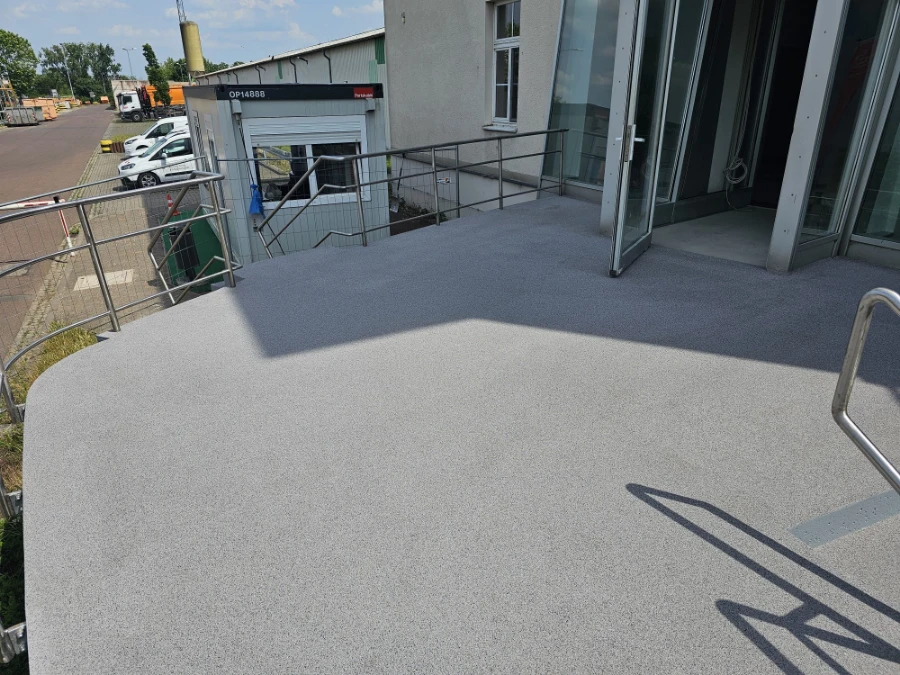
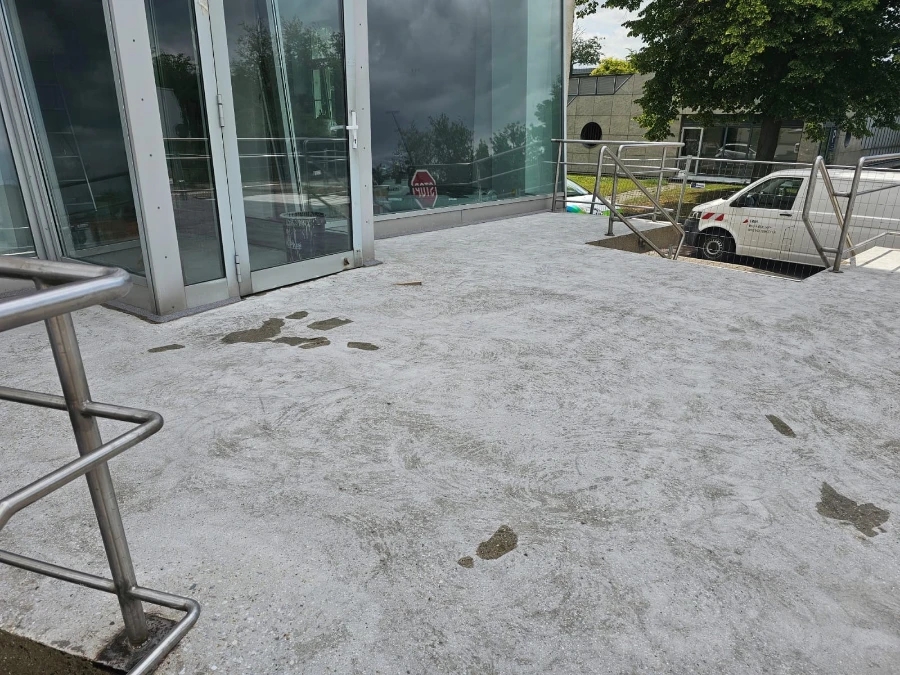
Workplace Safety · Traffic Routes · Water/Oil Spills · Cleanability · Stable Transitions
Types and Varieties of Slip-Resistant Flooring (R9-R13)
R9 - Dense, smooth wearing course for areas without regular media input
| Operating Principle | Slip resistance is achieved primarily through a controlled surface texture in the lower portion of the R-groups; the surface remains smooth and easy to clean. |
| Delimitation | No displacement chamber function; in the case of wet or oily feedstock, R9 is often insufficient if the area is classified higher according to ASR A1.5. |
| Typical Uses | dry mounting surfaces, Packaging, Internal paths with no significant entries |
| Design feature | Industry-specific field | Technical Significance | System/Detailed Approach |
|---|---|---|---|
| Temperature/Summer Load Case | seasonally relevant | Affects the tendency of asphalt to deform | Islands with push-stable integration |
| Deformation/Ruts in the Support Area | local to pronounced | Factors Affecting Island Size and Peripheral Zone | a larger support pad instead of a “small pad” |
| Support Island Dimensions | approx. 0.4 × 0.4 m to 1.0 × 1.0 m | Distributes pressure, reduces indentation | EP/PU/AC mortar islands, depending on inventory |
| Transition: Island ↔ Asphalt | chamfered/flush | Prevents chipping at the edge | Defined bevel, low-porosity finish |
| Thrust Loads During Maneuvering | medium-high | Risk of Shearing at the Edge of the Island | Sufficient embedment depth, edge zone bearing capacity |
| Moisture/External Source | highly possible | Prevent Water Seepage and Frost Damage | Smooth surface finish, precise details |
R10 - Fine-textured surface, optionally with V4 displacement chamber to prevent moisture and dirt ingress
| Operating Principle | A fine tread pattern or micro-scattered top layer increases slip resistance; in high-traffic areas, a displacement space may also be required. |
| Delimitation | Compared to R9, traction increases, while sensitivity to cleaning parameters (cleaning agents, residues) also increases. |
| Typical Uses | Indoor/Outdoor Entrance Areas, Changing Rooms/Restrooms, Transitions Between Indoor and Outdoor Areas, Traffic routes with periodic moisture |
R11 - Rough surface for work areas exposed to moisture, dirt, or oil
| Typical Uses | Wet Cleaning, Outdoor Service, Goal Zones, Areas with regular fluid inflow |
| Operating Principle | Moderate application creates a durable micro- and macrotexture; slip resistance remains more stable under varying application conditions. |
| Delimitation | Compared to R10, the roughness increases; cleaning becomes more challenging and must be tailored to the profile. |
R12 - Highly textured surface posing a high slip hazard (oil/pastes/film formation)
| Typical Uses | Areas with a high concentration of lubricant, frequent layer of moisture/grease, defined process areas |
| Delimitation | R12 is not a “standard surface” for logistics corridors; it is selected when the entry would otherwise reliably fall below the coefficient of friction values. |
| Operating Principle | A coarse, durable tread pattern with pronounced grooves reduces the direct lubricating film between the shoe and the surface. |
R13 - Maximum slip resistance for extreme wear with heavy buildup
| Typical Uses | Process areas with a continuous lubricating film, Very high moisture/media load |
| Delimitation | In many industrial environments, R13 is only useful in specific cases, as it significantly increases the effort required to clean the floor, as well as noise levels and the difficulty of moving over it. |
| Operating Principle | Very coarse profiling with a large displacement volume is designed for media that are extremely prone to slippage and high flow rates. |
Directional profiling (groove/grid principle) with directional evaluation
| Typical Uses | Entrance and Transition Zones, Areas with a defined path (direction of travel), Proximity to drainage |
| Delimitation | Compared to isotropic skid resistance, traction may vary in the transverse and longitudinal directions; traffic routing and pedestrian paths must be adapted accordingly. |
| Operating Principle | Slip resistance is achieved through linear profiles; when profiles are oriented, the evaluation is based on the most unfavorable average value in each direction. |
Zoned slip resistance (mixed-use surfaces) based on usage, traffic flow, and traffic routing
| Operating Principle | Different areas are assigned different R/V classes based on the classification tables in ASR A1.5 (e.g., exterior vs. interior entrances, ramps, wet areas). |
| Delimitation | Instead of selecting a high R-class “everywhere,” hotspots are protected in a technically targeted manner; transitions must be designed with precise geometry and functionality. |
| Typical Uses | Logistics (Gate Area), Production (Process Island), Service (Cleaning), Separate walking and driving paths |
Slip-resistant flooring (R9-R13)
A slip-resistant floor (R9-R13) is a functional surface treatment in which the slip resistance is classified as an R group based on the “inclined plane” walking test (ramp test); in addition, a displacement space ( V-class) may be required to accommodate or drain substances that promote slipping. (BAuA)
In industry, logistics, and commercial settings, the target class is derived from the actual substance present (e.g., water, oil, cleaning chemicals), traffic flow, and cleaning processes; ASR A1.5 provides classification tables for this purpose, organized by work areas. (BAuA)
Quantec Industrieböden® GmbH creates slip-resistant surfaces on existing floors using EP, PU, and AC systems —as part of repairs, spot repairs, or zoned refinishing—without the need to pour new concrete or screed and without installing click-lock flooring.

FAQ


Logistics & Warehousing (aisles, high-bay racking, material handling, gate/ramp)
Production & Mechanical Engineering (Machine Installation Areas, Traffic Routes, Built-in Components)
Food & Hygiene (Cleaning, Moisture, Sealing Paths, Detail Zones)
Cold Storage & Temperature Changes (Gradients, Condensation, Curing Window)
Slip-Resistant Flooring (R9-R13) — Suitable for High-Traffic Areas and Easy Cleaning
Please send us the area of use, the type of flooring, and the cleaning regimen. You will receive a structured assessment of the zoning and the appropriate R-class.
The content of this page is intended to provide general information about Non-slip flooring and does not constitute project-specific technical planning or a guarantee of specific properties. Since specific requirements and results depend on individual on-site conditions, no liability is assumed for the accuracy of this information.


INDUSTRIEBÖDEN ® GmbH

Your symptoms
The Quantec Solution
We will be happy to contact you.
Would you like a personal telephone consultation?