


You are here:
Spot Repair - Quickly Fix Damaged Areas in Industrial and Logistics Floors
Quantec Industrieböden® GmbH performs floor renovation on existing industrial, commercial, and logistics facilities—with precision, durability, and a clear approval process that minimizes disruption to ongoing operations.
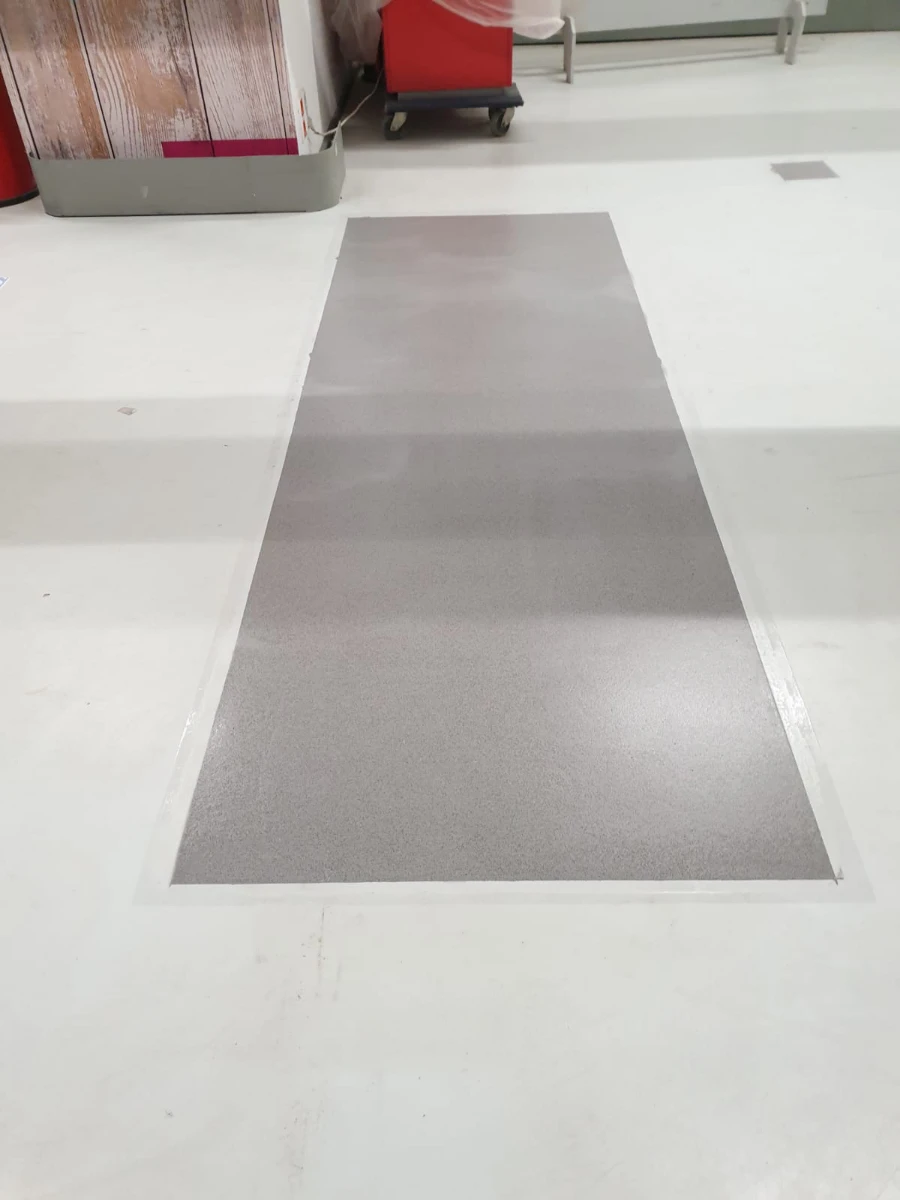
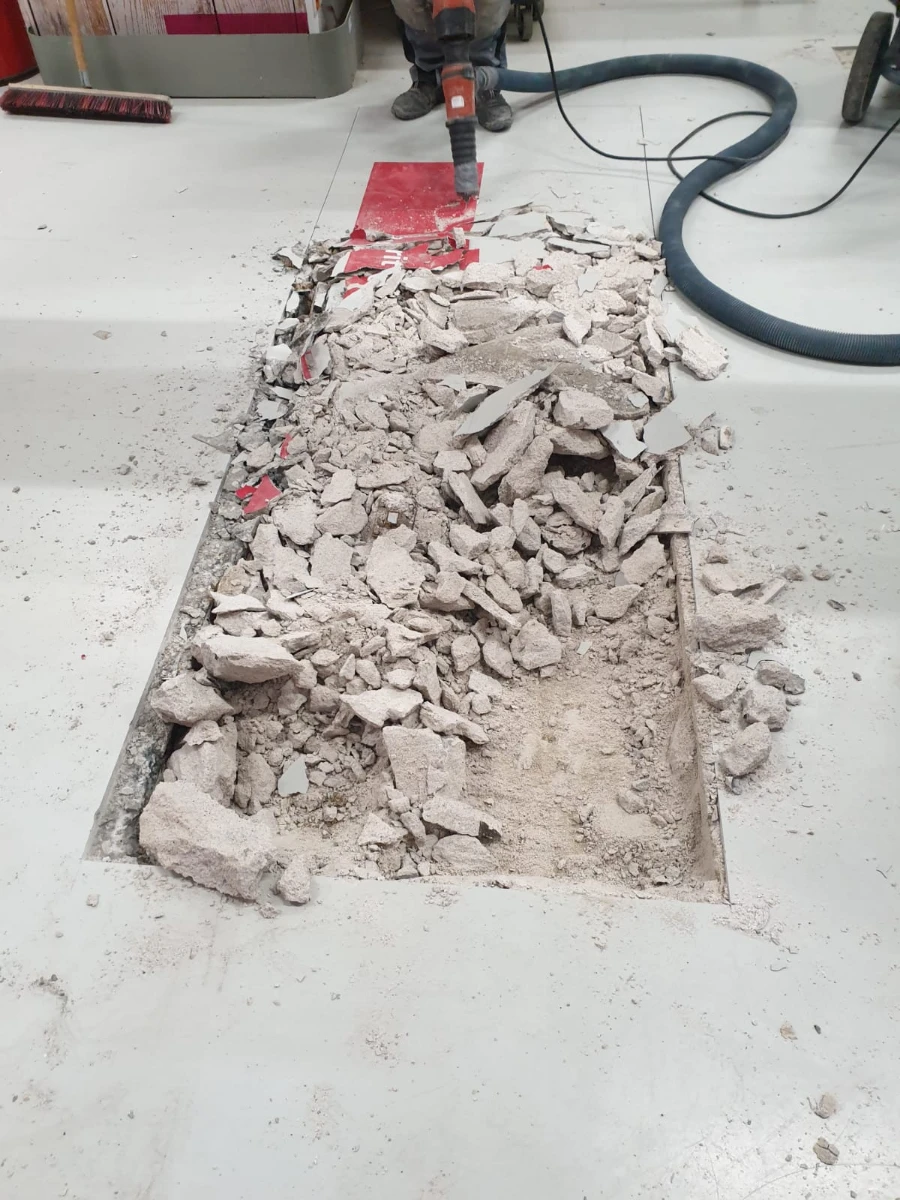
Localized spalling, flaking, and damaged or weakened edge areas are typical causes of recurring problems in traffic lanes and crossings. Spot repairs stabilize these hotspots before damage spreads and closed areas grow larger. Depending on the available time window, repairs are organized so that traffic routes remain usable in a controlled manner.
Why Quantec?
10-Year Warranty
Damaged areas in industrial floors require quick and durable solutions. With our many years of experience and our high-strength, fast-curing mortar systems, we can repair damaged areas within a few hours. This minimizes downtime and ensures that the affected areas are quickly restored to service.

Targeted Rather Than Widespread
Resolve hotspots without unnecessarily blocking the entire area.
Short downtime windows can be utilized
Implementation in coordinated phases, including during off-peak hours.
EP / AC / PU Systems
Select based on load profile, wear, and desired time to return to service.
In-House Machinery
No subcontractors, clear processes, reproducible results.
When Column Rehabilitation Is the Most Cost-Effective Solution
Not every type of damage requires a complete surface restoration. Spot repair is advisable when the problem is localized but has an immediate impact on operations.
Typical causes
Typical causes
- Damage in traffic lanes, aisleways, or picking zones
- Spalling at edges, transitions, or near joint edges
- Localized damage in door and ramp areas
- Localized exposure to substances (e.g., oil or cleaning agents) causing surface degradation
- Recurring minor repairs at the same location (indicating a problem in the edge zones)

Structural rehabilitation with seamless integration into the existing building
Quantec does not perform “cosmetic” repairs on damaged areas; instead, it repairs them in such a way that the repaired area can withstand loads and does not crack again at the edges. The key factors are the precise demarcation of the repair area, a stable edge zone, and a system design that is suited to the intended use.
Typical Project Workflow 1

Assessment

Chiseling

Renovated and sealed
Typical Project Workflow 2

Assessment

Prepared and chiseled out

Renovated and sealed
What Quantec's Column Rehabilitation Service Includes
Repair of Damaged Areas
- Repair of cracks, spalling, and localized loss of load-bearing capacity
- Stabilization of edge zones in traffic lanes and transitions
- Restoring drivability in hotspots
Interfaces with Joints / Cracks / Profiles
- Combine with crack repair if the edges of the cracks extend into the damaged area
- Integration into expansion joint repair, if joint edges are the cause
- Option: Heavy-duty profiles for mechanical reinforcement of edges
Surface stabilization (if necessary)
- System configuration with EP, AC, or PU, depending on the application
- Additionally: Sealing to reduce abrasion and dirt accumulation
- Markings as an add-on when traffic routing needs to be adjusted
EP, AC, or PU—What Factors Determine the Choice?
Important: Quantec renovates existing floors. The company does not perform new construction work involving concrete/screed or click-system flooring. Asphalt surfaces are repaired, but not newly laid.
EP (epoxy resin)
Suitable for high mechanical stress and heavy-duty repair areas
AC (acrylic resin)
advantageous when very short turnaround times are required
PU (polyurethane)
recommended when more elastic material behavior or dynamic loading is a factor
Repair without unnecessarily disrupting the flow of materials
Renovations of workstations can often be scheduled in such a way that main pathways are preserved. The key is to plan based on traffic flow, not on “square footage.”
Practical Guidelines
Practical Guidelines
- Repair windows based on shift schedules and traffic patterns
- Clear cordoning off of the zone with defined detours
- Temporary solutions for safe crossings (if necessary)
- Section-by-section reopening so that areas can be put back into use quickly

Where Structural Rehabilitation Is Used Most Frequently
Tire tracks from forklifts and pallet jacks
Transitions at gates, ramps, and crossings
Aisle sections with recurring point and rolling loads
Turning zones (e.g., near parking spaces and curbs)
Maintenance and workshop areas with local utility loads
Job Reorganization Process—Organized in a Transparent Manner
Close-up of the damaged area
You send photos, the location, and the use (lane, crosswalk, gate area). The goal is to prioritize quickly.
Define a redevelopment zone
The zone is delineated in such a way that peripheral areas are effectively incorporated and no new break-out edge is created.
Specify the system configuration
Select EP/AC/PU based on the load profile and the desired activation time.
Implementation and Approval
Implementation by our own team, followed by clear approval of the zone for operation.
Before
Afterward
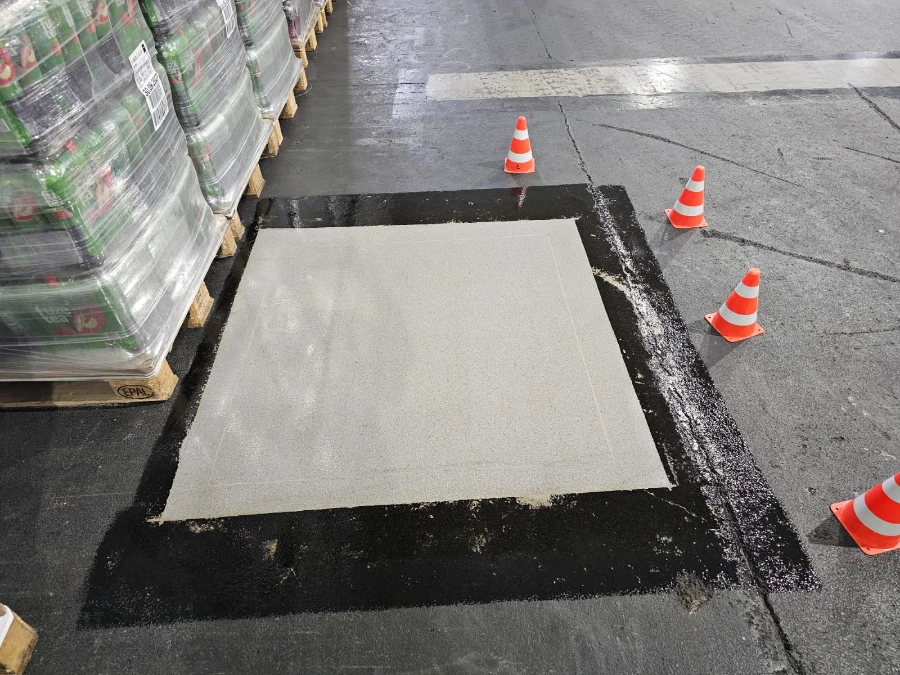
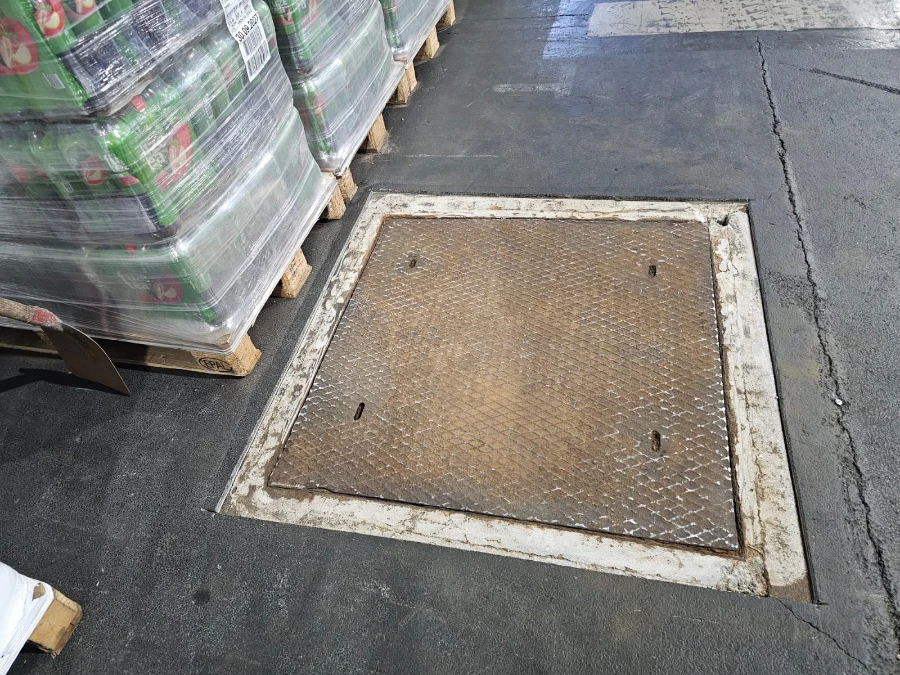
Industry | Logistics | Commercial · Traffic Lanes & Hotspots · Predictable Closure Times · Stable Transitions
Types and Variations of Column Rehabilitation
Pothole Repair Using Reaction-Curing Resin Mortar
| Operating Principle | The damaged area is clearly delineated, A load-bearing edge zone was created and rebuilt using a mortar system; the transition is flush/chamfered, to reduce shock loads |
| Typical Uses | Lanes, Intersections, Goal Lines, Recurring hotspots |
| Delimitation | Do not “apply putty over crumbly surfaces”; the load-bearing area and geometry are crucial |
| Decision Parameters | Industry-specific field | Relevance to Interpretation |
|---|---|---|
| Degree of intervention | approx. 15-80 mm | determines integration and perimeter security |
| Edge Profile | Chamfer/Radius | Impact Energy Management |
| Mortar System | EP (Reserve) / MMA (Short Window) | Release Time vs. Robustness |
| Traffic Profile | moderate to very high | Shock/impact loads dominate |
| Flatness Target | flush, without an edge | Drivability from Initial Release |
| Risk of Recurring Damage | high with poor transitions | Prioritize transitional training |
Chemical/Oil Contamination Hotspot (Media Zone) as Part of Structural Rehabilitation
| Typical Uses | Leakage points, Service Areas, Cleaning Stations |
| Delimitation | Without a media profile, “chemical-resistant” cannot be specified |
| Operating Principle | The contaminated zone is prepared technically as follows:, that adhesion and durability can be restored in the media profile; sealing details reduce the risk of infiltration |
| Decision Parameters | Industry-specific field | Relevance to Interpretation |
|---|---|---|
| Medium/Concentration | company-specific | System access is only available through this method |
| Exposure time | Splash contact to standing | Reserve Force/Advanced Training |
| Degree of contamination | superficial to deep | Intervention and Blocking Logic |
| Surface finish | low-porosity | Limit Infiltration |
| Transitions | flush, without a visible edge | No new vulnerability |
| Maintenance Logic | locally reproducible | Keep hotspots repairable using a modular approach |
Delamination/Hollow Layer Repair (Local Loss of Layer Bonding)
| Typical Uses | Coated surfaces with bubbles/peeling, Peripheral Areas, Repair History |
| Delimitation | Cosmetic surface repairs without structural restoration lead to rapid delamination |
| Operating Principle | Loose/decoupled areas will be removed, The subgrade was stabilized and the bond was restored using a new system design |
| Decision Parameters | Industry-specific field | Relevance to Interpretation |
|---|---|---|
| Extent of delamination | local to zonal | Define the repair area |
| Soil contamination | possible (oil/chemicals) | decides on pretreatment |
| Structural Concept | Mortar + Topcoat / Resurfacing | Consider the composite and the surface separately |
| Coating thickness | function-oriented | Not “fat,” but just right |
| Cleaning regimen | relevant | Topcoat Compatibility |
| Connection to Existing Infrastructure | low-porosity/flush | Avoid entry paths and edges |
Joint-Edge Repair in Wheel Load Lines
| Typical Uses | Forklift Axles, Curves, Intersections, Chipped edges along joints |
| Delimitation | Filling the joint alone does not resolve flank failure; start with the load-bearing flank, then joint function |
| Operating Principle | Damaged joint edges are re-profiled and rebuilt to be highly durable; optionally combined with profile/edge protection |
| Decision Parameters | Industry-specific field | Relevance to Interpretation |
|---|---|---|
| Flank damage | From edge chipping to spalling | Define the intervention limit |
| Shear stress | high when changing direction | Check the profile/edge protection |
| Connection Geometry | load-stabilized | prevents further flaking |
| System Selection | EP/AC(MMA) per time slot | Business logic controls materials |
| Addendum | Heavy-duty profile available | Mechanically decouple edge joints |
| Approval | zonal | Traffic Management During Construction |
Structural Rehabilitation of potholes in asphalt (existing pavement) in traffic and maneuvering areas
| Delimitation | No new asphalt will be laid; the goal is to restore functionality at critical points |
| Operating Principle | Local stabilization of asphalt surfaces through load-distributing islands/transition zones, to limit indentation and shear deformation |
| Typical Uses | Yard/Marshalling Areas, Adjustment Ranges, Outdoor Service |
| Decision Parameters | Industry-specific field | Relevance to Interpretation |
|---|---|---|
| Deformation pattern | Track groove/shear fold | Island-sized instead of micro-pad |
| Temperature/Summer Load Case | relevant | Shear Strength and Transition |
| Transition: Island ↔ Asphalt | chamfered/flush | Prevents edge chipping |
| System Selection | EP/PU/MMA (depending on the specific details) | Time Window and Robustness |
| Entry on the outside | Water/Dirt | Density/Edge Logic |
| Repairability | modular | Recurring hotspots are manageable |
Spot Repair of Industrial, Commercial, and Logistics Floors
Spot repair is a localized repair method used when damage occurs in specific areas but the surface as a whole remains usable. The technical decision is based on the damage mechanism (spalling, delamination, crack/joint edge failure, contamination), the load type (wheel load, point load, shear), and the joint geometry (flush, chamfered, profile-protected). In logistics and industry, repairs often fail not because of the material itself, but due to insufficient edge zone load-bearing capacity or poorly stabilized transitions. Quantec Industrieböden® GmbH performs spot repairs using EP, AC (MMA), and PU mortars; repairs to existing asphalt surfaces are carried out as restorations without the need to lay new pavement.

FAQ


Logistics & Warehousing
Manufacturing & Mechanical Engineering
Food & Hygiene
ESD & Special-Purpose Functional Surfaces
Chemistry/Media & WHG/AwSV
Request a Job Reassignment—with Clear Approval Criteria
Please send us details on the location of the damage, usage, and your preferred time frame. You will receive a detailed assessment and a recommendation for next steps.
The content of this page is intended to provide general information about Structural Rehabilitation and does not constitute project-specific technical planning or a guarantee of specific properties. Since specific requirements and results depend on individual on-site conditions, no liability is assumed for the accuracy of this information.


INDUSTRIEBÖDEN ® GmbH

Your symptoms
The Quantec Solution
We will be happy to contact you.
Would you like a personal telephone consultation?