


You are here:
Fast-curing industrial floor—quick reopening with a short closure period
Quantec Industrieböden® GmbH installs fast-curing industrial flooring as a renovation and coating system for existing facilities—ideal for industrial and logistics spaces where operations allow only a short time window.

When downtime is costly, it’s important to have a pavement structure that can be safely opened to traffic within tight time frames. Fast-curing systems are suitable for repairing hot spots, traffic lanes, and sections of the road without unnecessarily blocking the flow of traffic. The key factors are the choice of system, clean edge zones, and a reopening schedule that aligns with operational needs.
Why Quantec?
Your Partner for Durable Industrial Floor Renovation
We don’t see ourselves as merely a service provider, but as a reliable partner at your side. Every renovation is planned carefully and precisely, carried out using high-quality materials, and designed for long-term use. This results in cost-effective and durable solutions for your industrial floor.

Make the Most of Short Downtime Periods
Implementation in defined phases with controlled release.
Prioritize time-sensitive hotspots
Targeted repairs to traffic lanes, crossings, and parking spaces.
System Selection by Time Slot
Reaction resin systems based on application and approval requirements.
100% in-house work
Our own machinery—no subcontractors.
When the lockout period is the actual requirement
In logistics and production, the floor often cannot be refurbished “at any time,” but only during narrow process windows. Traditional measures then fail less because of technical limitations than because of time constraints: detours are limited, parking spaces must remain available, traffic lanes cannot be out of service for long, and main routes can only be closed for a short time.
Typical situations
Typical situations
- Renovation possible only in the evening, overnight, or on weekends
- Critical traffic arteries must not be blocked for extended periods
- Hotspots must be prioritized before consequential damage escalates
- Detours are only feasible to a limited extent from an operational standpoint
- Several sub-areas require rapid, repeatable approvals

Fast-curing industrial flooring as a commissioning solution
Quantec designs fast-curing flooring solutions that combine system architecture with section-by-section logic: Which areas need to be accessible to traffic again and by when, which transitions are critical, and which zones can be opened up one after another? This turns a “short closure period” into a predictable implementation process.
Features of Fast-Curing Floor Solutions
Time-Sensitive Renovation of Existing Buildings
- Repair of road sections in hotspots with rapid reopening
- Repair of lanes and crossings in prioritized sections
- Incorporation of peripheral areas to reduce recurring damage
Fast-curing coating systems (depending on the application)
- Selection of a reaction resin-based system that meets the approval requirements
- Surface configuration tailored to abrasion, traffic, and cleaning
- Implementation in sections with defined transition zones
Interface measures that ensure time windows
- Combine with expansion joint rehabilitation if joint edges are causing secondary damage
- Crack and spot repair prior to or during the stabilization of the zone
- Optional mechanical protection at edges/transitions in cases of recurring impact loads
Factors That Affect Curing and Release
Rapid curing is not just a matter of materials. In practice, operating windows, surface geometry, and transition design are key factors.
Relevant Parameters (Selection)
Release Target
Pedestrian traffic, pallet jacks, forklift traffic (staggered over time)
Time window
Night/weekend, shift changes, process interruptions
Hotspot Geometry
Lane widths, crossings, parking space axes
Peripheral Areas
Condition and Integration with the Existing Area
Cleaning
Interval and Chemistry in the Initial Phase Following Approval
Phased renovation with a clear traffic plan
Time-sensitive measures work when the process aligns with operational realities: traffic routes remain predictable, detours are clearly defined, and road openings are carried out in an order that safeguards the flow of materials.
Planning Components
Planning Components
- Segmentation by Priority Areas and Traffic Arteries
- Defined transitions between areas under construction and areas in use
- Operational windows with clear start and end points (e.g., shift changes or company holidays)
- Approvals per section based on the agreed-upon usage level

Typical Applications for Fast-Curing Industrial Floors
Logistics facilities with high utilization rates and minimal downtime
Lanes at gates and ramps that cannot be closed for long periods of time
Parking and transshipment areas with recurring peak loads
Production areas with tight maintenance windows
Remediation of Hotspots as a Preliminary Step Toward Future Land Optimization
Process: From Lockout to Safe Release
Closing Hours Check
They specify time slots, usage, and critical traffic areas.
Set Priorities
Hotspots and axes are sorted by operational relevance.
Determine the system direction
Selection of a fast-curing restoration system appropriate for the intended use and approved for that purpose.
Implementation in Phases
Work with clearly marked transition areas, barriers, and designated detours.
Approval and Operating Instructions
Approved release on a section-by-section basis, as well as instructions for use and cleaning during the initial phase.
Before
Afterward

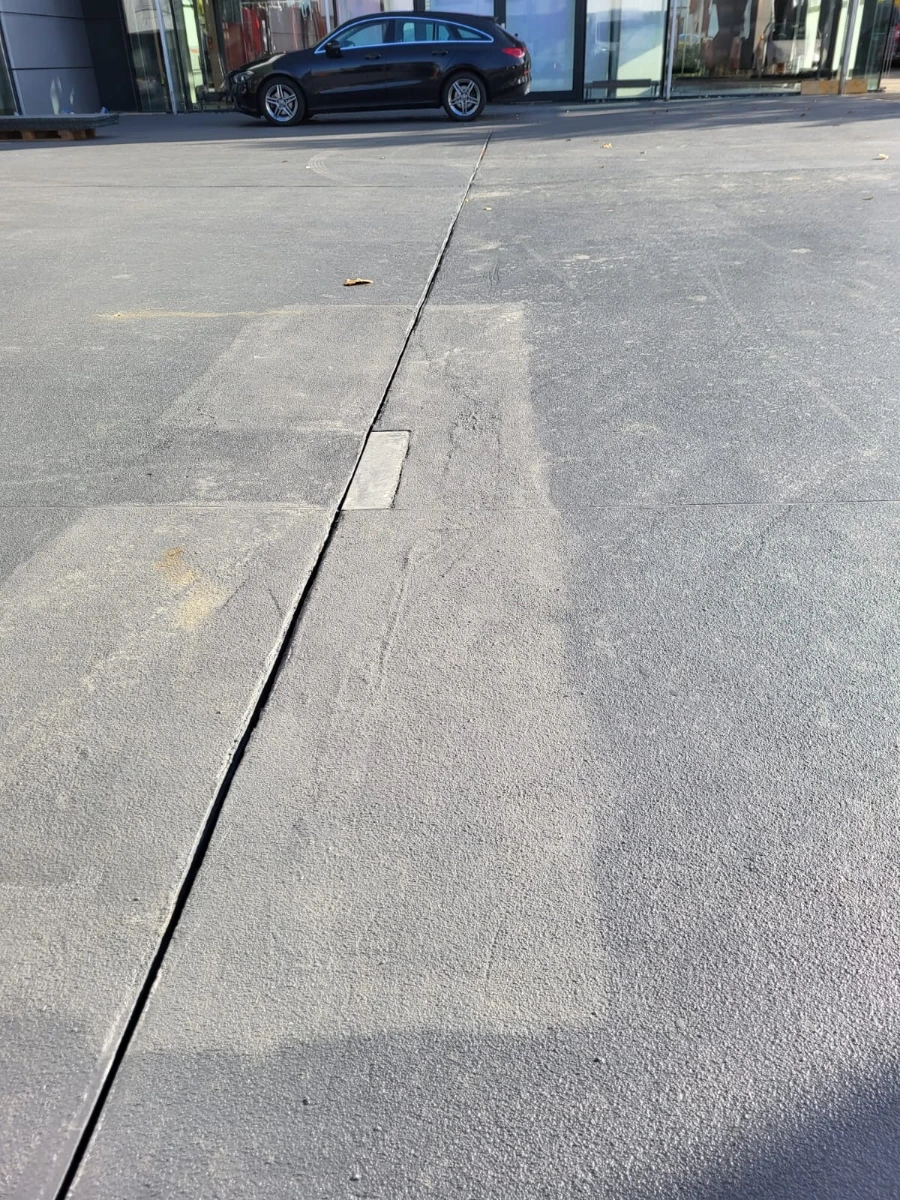
Night/Weekend Windows · Section Release · Hotspots · Scheduled Restart
Types and Varieties of Fast-Curing Industrial Flooring
Low-temperature version of fast-curing industrial floor (winter/cold zones)
| Operating Principle | System and process control are optimized for low ambient temperatures (reaction control, Section Cycles, Ventilation/Operating Logic). |
| Delimitation | No separate material class; it is a design and process variant, which addresses reaction stability within the temperature range. |
| Typical industrial applications | Gate areas near the perimeter, unheated sections of the hall, Winter maintenance without long downtimes. |
| Parameters | Industry-specific field | Relevance to Interpretation |
|---|---|---|
| Ambient temperature | low to moderate | Response Time / Approval |
| System Priority | MMA is often used for short windows; EP/PU for longer windows | Process Reliability |
| Release Planning | step by step | Grade usage by mode of transportation |
| Condensation/Moisture Risk | increased | Secure the joint and the surface finish |
| Section length | reduced | Controlled Reaction and Quality Management |
| Detailed points | particularly critical | Stabilize edges/transitions before the surface |
Fast-curing acrylic resin (MMA) self-leveling coating for short full-surface curing times
| Operating Principle | MMA coating creates a continuous wear layer, which can be reserved and driven during short time slots. |
| Delimitation | Lower “tolerance margin” for unstable edge areas compared to mortar structures; preliminary repairs in hotspots are often necessary. |
| Typical industrial applications | Production areas with weekend availability, defined hall sections, Logistics facilities with a bypass. |
| Parameters | Industry-specific field | Relevance to Interpretation |
|---|---|---|
| Coating thickness | approx. 2.0-4.0 mm | Wear Reserve vs. Flatness |
| Accessibility | approx. 30-90 min | Release Schedule for Sub-Areas |
| Passability | Approx. 2-4 hours (depending on usage) | Early wheel load measurement |
| Surface option | smooth to finely textured | Cleaning vs. Basic Traction |
| Segment length per cycle | approx. 200 m² | Traffic Management During Operations |
| Temperature range | Project-dependent (response-sensitive) | Ensure process stability |
Fast-curing formation of detailed areas at joints, edges, and embedded components
| Operating Principle | Critical areas are stabilized with fast-setting mortars or resins before the surface is approved (smoothing out edges), Creating Stable Flanks, (Eliminate collision lines). |
| Delimitation | No separate “land-use variant”, but rather a prioritized detailed strategy, which ensures early operational readiness. |
| Typical industrial applications | Joint Perimeter Zones, Transitions at Gates, Manhole/Gutter Edging, Profile connections. |
| Parameters | Industry-specific field | Relevance to Interpretation |
|---|---|---|
| Detail Type | Joint Flank / Edge / Connection | determines the choice of system and geometry |
| System Selection | MMA (Short Window) / EP (Reserve) / PU (Dynamic) | Approval vs. Mechanical Robustness |
| Target Geometry | flush, chamfered, without a sharp edge | reduces impact energy and spalling |
| Degree of intervention | approx. 20-120 mm (depending on the details) | Integration and Breakaway Protection |
| Section cycle | small (hotspot-first) | Operational Capability During Implementation |
| Early-life stress | along major transportation routes | Prioritize the details first |
Fast-curing epoxy resin thin-film/self-leveling coating for time-optimized surface refinishing
| Operating Principle | Fast-curing EP systems enable rapid surface restoration (sealed, (low-wear) with a controlled hold time. |
| Delimitation | No "instant approval" like MMA; makes sense, even if the time frame is tight, but isn't extremely short. |
| Typical industrial applications | Workshop/Service Areas, Storage Zones, Sections with predictable downtime. |
| Parameters | Industry-specific field | Relevance to Interpretation |
|---|---|---|
| Coating thickness | approx. 0.5-3.0 mm | Functional Objective: Sealing vs. Wearing Course |
| Accessibility | about 6-12 hours | Schedule for the Weekend Window |
| Passability | approx. 12-36 hours | Traffic Opening Based on Load Profile |
| Surface character | smooth to slightly textured | Care/Cleaning Guidelines |
| Chemical Input | depends on the operation | System Approval by Medium/Exposure Time |
| Pre-repair needs | frequently in hotspots | Thin-film systems are sensitive to the substrate |
Fast-curing acrylic resin (PMMA) repair mortar for hot spots and high-traffic areas
| Operating Principle | Fast-curing PMMA mortar restores local load-bearing capacity and geometry (flush/chamfered transitions) in spalled and impact zones. |
| Delimitation | The focus is on restoring structure and edges, Does not create a flat appearance; ideal for immediate re-traffic. |
| Typical industrial applications | Goal Lines, Intersections, Lanes, edge breaks near joints, Areas where point loads predominate. |
| Parameters | Industry-specific field | Relevance to Interpretation |
|---|---|---|
| Accessibility | about 60 min | Scheduling During the Night Window |
| Passability (internal) | about 2-3 hours | Phased reopening to traffic |
| Local installation height | approx. 5-40 mm | Clearance Height and Edge Clearance |
| Pot life | about 10-25 min | Installation Layout / Section Length |
| Edge Profile | Chamfer/Radius Defined | Reducing Impact Energy at Transitions |
| Ground state | stable, clean, dry to slightly damp | Composite Strength and Early Strength |
Fast-curing epoxy resin (EP) repair mortar for robust edge and flank repairs
| Typical industrial applications | Joint Flanks, Transitions to Built-In Components, Breakouts in forklift axles (when the time window is longer than the short window). |
| Delimitation | Typically longer suspension periods compared to MMA, In return, it offers high mechanical strength and stable edge formation. |
| Operating Principle | EP mortar restores high-strength edge and flank zones, especially there, where impact and shear forces drive the progression of damage. |
| Parameters | Industry-specific field | Relevance to Interpretation |
|---|---|---|
| Local installation height | approx. 10-50 mm | Load-bearing area and profiling |
| Accessibility | about 6-12 hours | Planning for a Partial Shutdown |
| Passability | approx. 12-24 h | Space out the wheel load mounts securely |
| Pot life | about 20-45 min | Blended/Integrated Organizational Structure |
| Edge and Flank Strength | high | Critical for crossings |
| Substrate Requirements | dry, stable, clean | Composite and Long-Term Stability |
Fast-curing MMA surface treatment system for high-friction traffic areas that can withstand early traffic loads
| Operating Principle | Grit + Sealing Create a Slip-Resistant Surface, A wear-resistant surface with a short curing time. |
| Delimitation | Requires more cleaning effort than smooth finishes; the level of texture must be appropriate for the installation and maintenance process. |
| Typical industrial applications | Gate and Ramp Zones, Intersection Areas, wet or dirty paths, Transitions between exterior and interior. |
| Parameters | Industry-specific field | Relevance to Interpretation |
|---|---|---|
| System Thickness | approx. 3.0-6.0 mm | Structural Capacity Under Shear |
| Target Structure | fine to medium (can be zoned) | Traction vs. Cleanability |
| Accessibility | approx. 45-120 min | Use of Operating Windows |
| Passability | about 2-6 hours | Approval by Mode of Transportation |
| Entry Profile | Water/Dirt/Cleaning | determines the choice of structure and topcoat |
| Transitions | flush, without a visible edge | Prevents breakouts at zone boundaries |
Fast-curing industrial floor
A fast-curing industrial floor is used when repairs and surface treatments must be carried out within very short closure windows (nighttime/weekend operations, phased reopening, detour routes). From a technical standpoint, reaction kinetics, temperature range, pot life, coating thickness, and the actual load conditions (wheel load, shear forces, point loads) determine the appropriate system variant.
In logistics, production, and workshop areas, detailed treatment of transitions, edges, and joint perimeter zones is crucial to decision-making, as this is where the earliest traffic loads occur. Quantec Industrieböden® GmbH implements fast-curing solutions in existing facilities using acrylic resin, epoxy resin, and polyurethane systems, without the need for new concrete or screed and without laying asphalt or PVC.
In logistics, production, and workshop areas, detailed treatment of transitions, edges, and joint perimeter zones is crucial to decision-making, as this is where the earliest traffic loads occur. Quantec Industrieböden® GmbH implements fast-curing solutions in existing facilities using acrylic resin, epoxy resin, and polyurethane systems, without the need for new concrete or screed and without laying asphalt or PVC.

FAQ


Logistics & Warehousing
Manufacturing & Mechanical Engineering
Food & Hygiene
Cold Storage & Temperature Fluctuations
Chemistry/Media & WHG/AwSV
ESD & Special-Purpose Functional Surfaces
Fast-curing industrial flooring—tailored to your schedule
Please send us the time slots, usage, and affected zones. You will receive a structured assessment of section planning and system direction.
The content of this page is intended to provide general information about Fast-curing industrial floor and does not constitute project-specific technical planning or a guarantee of specific properties. Since specific requirements and results depend on individual on-site conditions, no liability is assumed for the accuracy of this information.


INDUSTRIEBÖDEN ® GmbH

Your symptoms
The Quantec Solution
We will be happy to contact you.
Would you like a personal telephone consultation?