


You are here:
Industrial Floor Coatings - Protective Systems for High-Traffic Areas
Quantec Industrieböden® GmbH installs industrial floor coatings on existing industrial, logistics, and commercial spaces—tailored to load profiles, operational needs, cleaning requirements, and special requirements such as WHG or ESD.
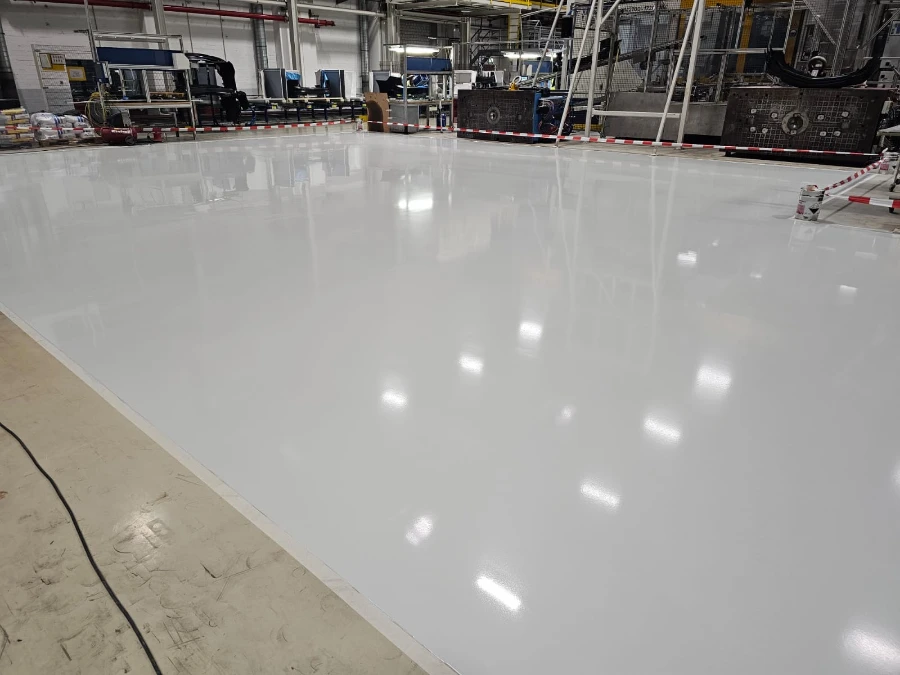
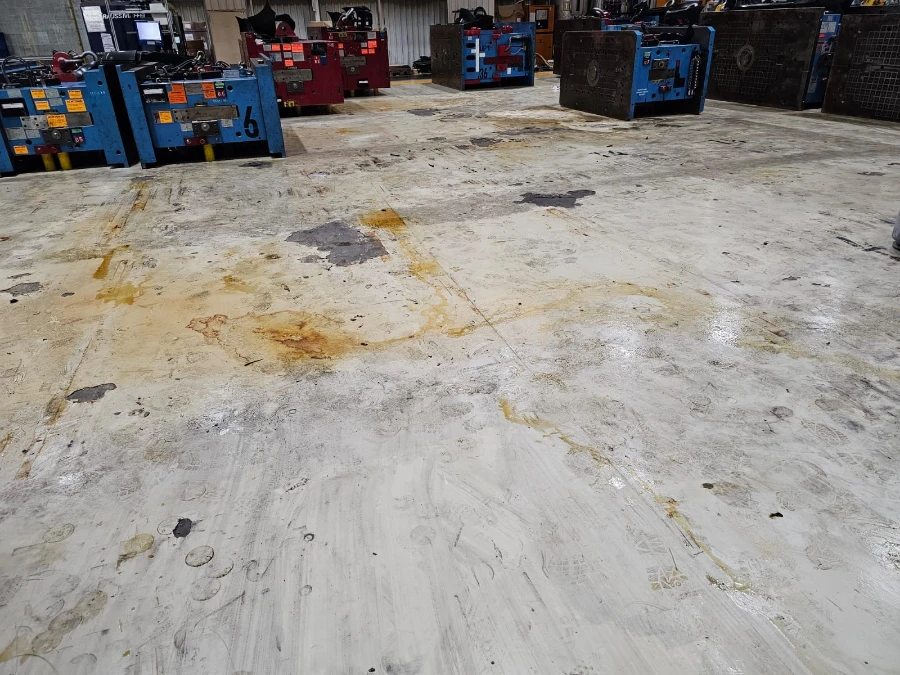
An industrial floor coating is cost-effective when it is suited to its intended use: abrasion, point loads, contact with substances, and downtime determine the system design. Quantec does not apply coatings “according to standard” but rather according to clear target parameters—including robust detailing at transitions, edge zones, and critical hotspots. New concrete or screed installations, as well as click-lock flooring, are not included in the scope of services; the focus is on the repair and coating of existing floors.
Why Quantec?
Your Partner for Durable Industrial Floor Renovation
We don't see ourselves as merely a service provider, but as a reliable partner by your side. Every renovation is planned carefully and precisely, carried out using high-quality materials, and designed for long-term use. This results in cost-effective and durable solutions for your industrial floor.

System Architecture by Use Case
Selection of EP/AC/PU based on wear, loads, and operating logic.
Special requirements can be met
WHG, ESD/conductive, slip resistance, and chemical resistance.
Scheduled Closure Times
Phased implementation in coordinated releases.
100% in-house work
Our own machinery—no subcontractors.
Which industrial floor coating is the right one?
Industrial floor coatings differ not only in terms of material, but also in function and intended use. This page explains the underlying logic: which requirements matter in practice, how to make a selection, and which special versions are appropriate.

Acrylic resin coating

Epoxy Resin Coating

Polyurethane coating
The 6 Factors That Determine the Right Coating
Mechanical Stress
Forklift traffic, lanes, point loads, impact zones, maneuvering areas.
Media Contact / Chemistry Profile
Oils, cleaners, process media, exposure times, temperature.
Blocking Period and Release
Shift operations, night/weekend windows, section logic.
Surface Properties
Abrasion resistance, ease of cleaning, traction/slip resistance, visual orientation.
Special Requirements
WHG/AwSV, conductive/ESD-compliant design, defined slip resistance classes.
Detail Zones
Transitions, peripheral areas, joints, edges, ramps, and gate areas.
From Damage Assessment to a Stable Foundation

Ground Prepared

Floor primed

Scratch-coat application for leveling

Partially coated surface

Finished Surface
What materials do we use?
Our Coating Systems: EP, AC, and PU
For industrial floor coatings, Quantec uses multi-layer reactive resin systems, the selection of which depends on the intended use, curing time, chemical exposure, and mechanical stress. For existing floors, coatings made of epoxy resin, acrylic resin, and polyurethane are particularly relevant.
The systems differ in terms of load-bearing capacity, elasticity, chemical resistance, surface texture, and time to re-use. This page provides an overview to help you classify them. You can find in-depth technical information on construction, variants, and areas of application on the respective detail pages.
The systems differ in terms of load-bearing capacity, elasticity, chemical resistance, surface texture, and time to re-use. This page provides an overview to help you classify them. You can find in-depth technical information on construction, variants, and areas of application on the respective detail pages.
Comparison of Coating Systems
| Feature | Epoxy Resin (EP) | Acrylic resin (AC) | Polyurethane (PU) |
|---|---|---|---|
| Typical Applications | Production, Workshop, Warehouse, Forklift Traffic | Logistics areas, loading docks, traffic routes, renovations during operations | Commercial and retail spaces, food courts, lounge areas |
| Mechanical Strength | Very high | high | moderate to high |
| Elasticity | low | low to moderate | high |
| Chemical resistance | Very high | good to very good | good |
| Water resistance | very good | very good | good |
| Electrically Conductive / ESD | possible | restricted | possible |
| Slip resistance | possible | possible | possible |
| Suitable for food-contact areas | restricted | possible | very well suited |
| Suitable Substrates | Concrete, Screed | Concrete, screed, existing coatings | Concrete, screed, and mastic asphalt are possible |
| Optical Properties | colored, glossy to matte | colored, matte to textured | colored, UV-resistant |
| Application Temperature | from about 10 °C | approx. −5 °C to 30 °C | from about 10 °C |
| Processing time | approx. 20-90 min | about 25 min | about 15-50 min |
| Accessibility | approx. 10-36 h | approx. 25 min - 3 h | approx. 15-36 h |
| Chemical Resistance | about 2-3 days | very quickly | about 2-3 days |
| Full mechanical load capacity | about 7 days | very quickly | about 7 days |
| Coating thickness | approx. 1-5 mm | approx. 2-6 mm | starting at about 1.5 mm |
| Solvent-free | Yes | Yes | Yes |
| Typical Advantage | maximum load capacity | very short lockout period | flexible, light-resistant |
| Typical limitation | longer curing time | Odor During Processing | No extremely high point loads |
When is which coating appropriate?
| Requirement / Situation | Recommended System | Justification |
|---|---|---|
| Very high mechanical stress, forklift traffic | Epoxy Resin (EP) | High compressive strength and abrasion resistance |
| Production areas with oil, cleaning agents, or chemicals | Epoxy Resin (EP) | Very high resistance to media and chemicals |
| Short downtime, quick restoration required | Acrylic resin (AC) | extremely fast curing |
| Renovation Without Interrupting Operations | Acrylic resin (AC) | Short downtime periods are possible |
| Low processing temperatures | Acrylic resin (AC) | Processing Even at Low Temperatures |
| A springy floor is required | Polyurethane (PU) | elastic and deformable |
| Mastic asphalt base layer | Polyurethane (PU) | Well-suited for mastic asphalt |
| Areas with visual requirements | Polyurethane (PU) | Lightfast and visually appealing |
| Food service establishments or commercial kitchens | Polyurethane (PU) | Suitable for heavy-duty use involving frequent exposure to water and cleaning |
| Slip resistance required | EP / AC / PU available | depending on the system configuration and surface structure |
| Electrically Conductive Flooring (ESD) | EP or PU | Conductive systems available |
Industrial Floor Coating with Epoxy Resin
Epoxy resin is primarily used on industrial surfaces that are exposed to high mechanical stress. These include production areas, workshops, storage areas, and traffic areas where forklifts are in operation. The coating forms a high-strength, seamless wear layer that is resistant to many substances, such as oils, cleaners, alkalis, and diluted acids.
Depending on the system configuration, it is also possible to create slip-resistant surfaces, electrically conductive ESD floors, or coatings compliant with the German Water Resources Act (WHG). This makes an industrial floor coating with epoxy resin particularly suitable for areas where high load-bearing capacity and long-lasting protection are paramount.
Depending on the system configuration, it is also possible to create slip-resistant surfaces, electrically conductive ESD floors, or coatings compliant with the German Water Resources Act (WHG). This makes an industrial floor coating with epoxy resin particularly suitable for areas where high load-bearing capacity and long-lasting protection are paramount.
Industrial Floor Coating with Acrylic Resin
Acrylic resin is used when very short downtime periods and rapid reopening are critical. The system is particularly well-suited for logistics areas, loading docks, traffic routes, and renovations during ongoing operations. Thanks to its fast curing time, even tight nighttime, weekend, or production windows can be better utilized.
Depending on the specific formulation , smooth, easy-to-clean, or slip-resistant surfaces are possible. Another advantage is that it can be applied even at low temperatures. An industrial floor coating with acrylic resin is therefore particularly useful when downtime must be kept to a minimum.
Depending on the specific formulation , smooth, easy-to-clean, or slip-resistant surfaces are possible. Another advantage is that it can be applied even at low temperatures. An industrial floor coating with acrylic resin is therefore particularly useful when downtime must be kept to a minimum.
Industrial Floor Coating with Polyurethane
Polyurethane is used when, in addition to protection , elasticity, light resistance, comfort, or specific surface properties are required. The coating is elastic, shrinkage-free, and can also be applied to mastic asphalt . This makes it suitable for select commercial and industrial areas with specific requirements for the substrate and surface. Depending on the system configuration , smooth, easy-to-clean, slip-resistant, or electrically conductive surfaces can be created. A polyurethane industrial floor coating is particularly suitable where elasticity and compatibility with the substrate are more important than maximum mechanical load-bearing capacity.
Which industrial floor coating is best suited for which situation?
The right industrial floor coating always depends on how the area will be used. For production and storage areas subject to heavy loads, epoxy resin is often the best choice. If very short downtime is a priority, acrylic resin offers advantages . Whenever elasticity, mastic asphalt as a subbase, or specific surface properties are important, polyurethane is often the best option . Important: Quantec coats and renovates existing surfaces. New construction work involving concrete or screed, as well as click systems or tile flooring, is not included in the scope of services. PVC or asphalt surfaces can be repaired but not newly installed.
Special versions that are frequently requested
WHG Coating (Sealing Surface)
For plant areas handling water-polluting substances. The focus is on leak-tightness, chemical resistance, and detailed design.
Conductive Flooring / ESD Flooring
For areas where electrostatic discharge must be prevented. Key considerations include defined conductivity parameters and technical integration into the overall design. Slip resistance
R9-R13
Slip resistance is achieved through surface configuration and system selection—while taking cleanability into account.
Chemical-Resistant Industrial Flooring
Design based on a list of substances, exposure times, and cleaning procedures. The goal is to ensure consistent resistance during operation.

Coating Existing Surfaces: Substrates, Edge Areas, Transitions
The durability of a coating depends not only on the material but also on the condition of the existing surface. Edge areas, transitions, tire tracks, and joint areas are particularly critical. For this reason, the surface is inspected before coating and—if necessary—repaired to ensure that the wearing course remains functional over the long term.
Typical preparatory work (depending on the condition)
Structural Repair in Areas with Spalling and Hotspots
Crack Repair to Stabilize the Surface
Expansion Joint Repair to Reduce Edge Spalling
Transition and edge stabilization, with mechanical protection if necessary
Clarify the requirement
Usage, load profile, media contact, cleaning, time window.
Specify the system architecture
Selection of EP/AC/PU and surface configuration, including special requirements or specific color requests.
Prepare Inventory
Repair edges, transitions, joints, and cracks to ensure the coating adheres properly.
Coat and Release
Phased implementation, defined transitions, clear approval for operation.
Before
Afterward
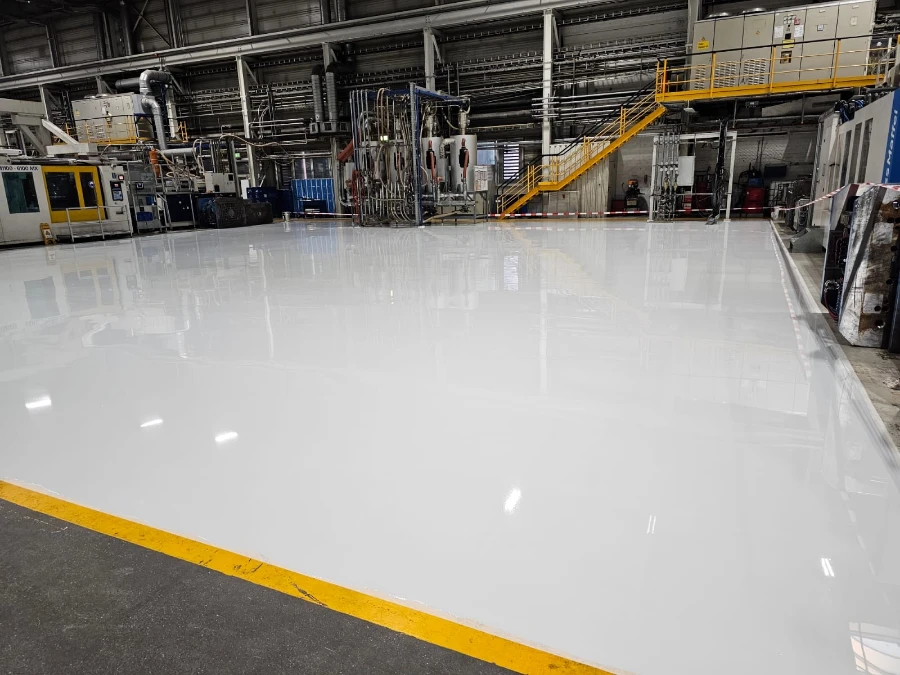
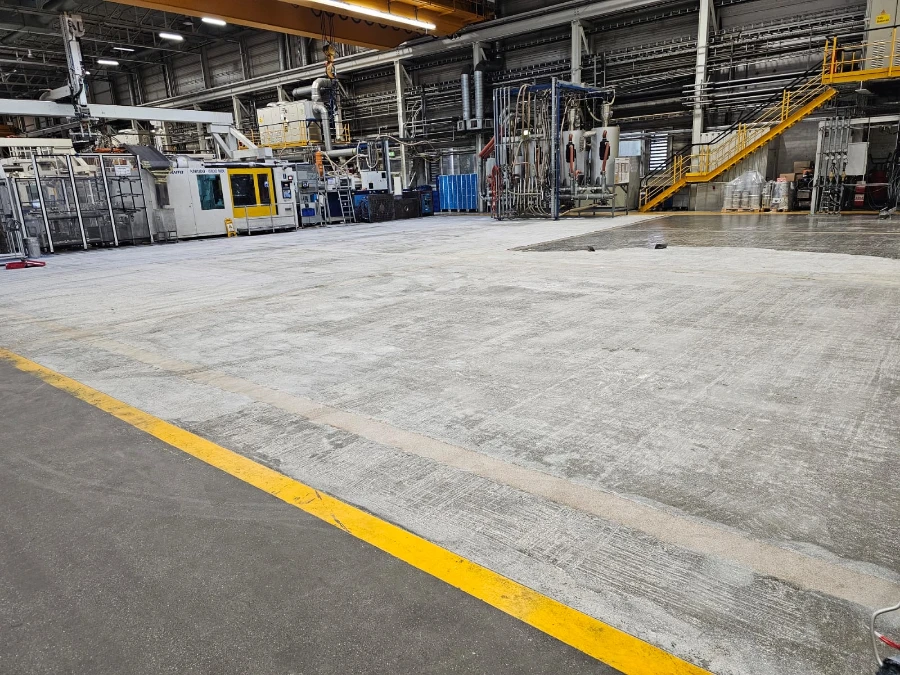
Manufacturing | Logistics | Commercial · Abrasion & Point Loads · Chemical Resistance · Defined Surface Finish
Types and Variants
Conductive Industrial Floor Coating (ESD)
| Operating Principle | The coating system is designed to maintain a specified level of conductivity during operation, Interfaces (zones, transitions) are part of the design |
| Delimitation | ESD is not an “add-on,” but rather system integration that includes detailed training, Wear zones are particularly critical |
| Typical industrial applications | Assembly and Testing Areas Related to Electronics, Defined ESD paths and transfer zones |
| Parameters | Industry-specific field | Meaning |
|---|---|---|
| Target Derivation Range | dissipative (system-dependent) | Functional Requirements by Zone |
| Wear/Traffic Profile | low-medium (typical) | Functional stability over time |
| Transitions to Standard Areas | planned/defined | prevents service interruptions |
| Effect of Cleaning | relevant | Surface Stability in Everyday Life |
| System Foundation | EP / PU / AC | Selection by Company & Time Slot |
AC/MMA Coating System
| Delimitation | Greater traction than smooth MMA finishes, The structure should be designed in zones to keep cleaning and dirt accumulation under control |
| Typical industrial applications | Forklift Crossings, Ramps, Doorways where moisture or dirt can enter |
| Operating Principle | MMA binder course with aggregate for the rapid construction of slip-resistant traffic surfaces |
| Parameters | Industry-specific field | Meaning |
|---|---|---|
| Total layer thickness | 3,0-6,0 mm | Structural load-bearing capacity, wear reserve |
| Slip resistance (purpose-specific) | R9-R13 (can be zoned) | Safety Feature in High-Risk Areas |
| Time until the area is accessible | about 1-2 hours | short lockout period |
| Time until it\'s ready to drive | about 2-4 hours | rapid return to service |
| Cleaning Effort | medium-high (depending on the structure) | Choose the appropriate texture level |
Acrylic Resin Coating (AC/MMA)
| Typical industrial applications | Goal Lines, Bottlenecks, Intersections, Areas with night/weekend shifts |
| Operating Principle | Fast-curing system (MMA-based) for time-critical applications, Approvals can typically be scheduled within narrow operational windows |
| Delimitation | Motivated primarily by time slots, Inventory preparation and detailed training remain technically crucial to ensure that rapid release does not lead to consequential damage |
| Parameters | Industry-specific field | Meaning |
|---|---|---|
| Total layer thickness | 2,0-4,0 mm | Power reserve with a short hold time |
| Time until the area is accessible | about 1-2 hours | Release Planning |
| Time until drivable (varies) Time until chemically resistant | about 2-4 hours about 4-6 hours | Phased Traffic Management |
| Temperature range (system-dependent) | Wide, but keep in mind | Reactivity/Predictability |
| Odor and Emissions Management | project-dependent | Organization During Ongoing Operations |
Chemical-Resistant Industrial Floor Coating
| Operating Principle | Stability is determined based on the medium, exposure time, temperature, and cleaning, Hotspots are being specifically reinforced |
| Delimitation | Not a blanket “chemical-resistant” designation, but rather a system design tailored to specific media, Mechanical stress remains equally important |
| Typical industrial applications | Service Areas, Process Zones Using Cleaning Chemicals, Areas in contact with oil or other fluids |
| Parameters | Industry-specific field | Meaning |
|---|---|---|
| Media List/Exposure Time | company-specific | key basis for interpretation |
| Cleaning (Chemical/Mechanical) | company-specific | Affects surface/topcoat |
| Choice of Structure | zoned | Safety vs. Maintenance Effort |
| System Foundation | EP / AC / PU | Filter by Media & Blackout Period |
| Entry Zones (Cracks/Edges) | to renovate | prevents infiltration |
EP Reaction Resin Mortar (Filler/Mortar System)
| Operating Principle | EP mortar is applied with a trowel, is used for building up/shaping and mechanically stabilizing hotspots |
| Delimitation | No “standard panel system” for every zone, but rather one specifically designed for repair/transition points and local reinforcements, is often combined with a coating as a wear layer |
| Typical industrial applications | Peripheral Areas, Transitions, chipped areas, Edge formations at crossing points |
| Parameters | Industry-specific field | Meaning |
|---|---|---|
| Order Volume | 4-12 mm (local) | Profiling, Edge Load-Bearing Capacity |
| Resistance to Pressure and Impact | high | Suitable for areas subject to point loads and impact |
| Geometry/Profiling | defined (template/radius) | reduces edge chipping and spalling |
| Compatibility | high | Base for EP/PU/AC wear layers |
| Blocking period (depending on the system) | approx. 8-24 h | Reactivation by Zone |
Thin Epoxy Resin Coating
| Operating Principle | Thin EP structure as a continuous wearing course, Mechanical protection against abrasion with a moderate coating thickness |
| Delimitation | Thinner coating than an EP self-leveling coating, less "cushioning" for uneven surfaces, suitable if the ground is firm and relatively level |
| Typical industrial applications | Workshop and Assembly Areas, Warehouse areas with moderate vehicle traffic, ancillary technical areas |
Epoxy Resin Self-Leveling Coating (EP-Self-Leveling)
| Operating Principle | Self-leveling EP system that forms a uniform, denser wear layer with a defined thickness |
| Delimitation | Thicker and more resistant to loading than a thin coating, less "edge-supporting" than scattered systems when subjected to very high shear forces |
| Typical industrial applications | Production Areas, Picking Areas, High-traffic areas that are cleaned regularly |
Polyurethane (PU) Coating
| Operating Principle | PU systems can be designed to be more flexible and respond better to dynamic loads or slight ground movements |
| Delimitation | Compared to EP, it often exhibits different surface and wear characteristics, Durability is defined more by the system's composition and the topcoat |
| Typical industrial applications | Areas with varying loads, Areas with recurring vibration/oscillation, Areas with increased comfort/acoustic requirements (depending on the application) |
| Parameters | Industry-specific field | Meaning |
|---|---|---|
| Total layer thickness | 0,8-2,5 mm | Elasticity vs. Wear Reserve |
| Crack Bridging (system-dependent) | low-medium | relevant for dynamic micro-movements |
| Surface options | smooth to textured | Traction/Appearance/Cleaning |
| Scratch and Scratch Mark Performance | depending on the application | Selection by Traffic and Usage |
| Closed until open to the public | approx. 12-24 h | Section Approval |
| Waiting period until full weight-bearing is permitted | approx. 48-96 h | Traffic Survey |
PU Self-Leveling Coating
| Operating Principle | Self-leveling PU system, when a defined slope with a functional surface (e.g., ease of cleaning/traction) is required |
| Delimitation | Compared to thin-film PU systems with a greater film thickness, generally structured in a less “aggressive” manner than EP-Astreuen |
| Typical industrial applications | Production and assembly areas that are cleaned regularly, Areas where a uniform surface is required |
| Parameters | Industry-specific field | Meaning |
|---|---|---|
| Total layer thickness | 2,0-4,0 mm | Wear Layer Reserve, Gradient |
| Surface Settings | finely textured to smooth | Balance: Traction/Cleaning |
| Cleaning Profile | dry/wet, interval relevant | Affects topcoat/texture |
| Transitional Training | mandatory | Preventing Edge Breakage |
| Closed until open to the public | approx. 12-24 h | Operating Window |
| Waiting period until full weight-bearing is permitted | approx. 48-96 h | Full operation |
Slip-Resistant Industrial Floor Coating (R9-R13)
| Operating Principle | The surface texture is selected so that high-risk areas are slip-resistant, Standard surfaces remain easy to maintain |
| Delimitation | Not “one texture for everything,” but functional zoning (e.g., wet/oily vs. dry) |
| Typical industrial applications | Walking routes, Intersections, Cleaning Zones, Gate/Ramp Area |
| Parameters | Industry-specific field | Meaning |
|---|---|---|
| Target Slip Resistance | R9-R13 (zoned) | Security Level by Zone |
| Degree of structure | fine-coarse | Cleanability vs. Traction |
| Entry Profile | Moisture/Dirt/Oil | defines zone boundaries |
| Transition Details | defined | Prevents edges/dirt traps |
| System Foundation | EP / AC / PU | Filter by Usage & Blocking Period |
Fast-curing industrial floor coating
| Operating Principle | The setup and process are designed to allow for short closures and a phased reopening, Transitions must be structurally secured |
| Delimitation | The time frame determines the choice of materials and procedures, not the other way around, Hotspot repair and in-depth training are mandatory |
| Typical industrial applications | High-traffic logistics corridors, Goal Areas, Bottlenecks with Night/Weekend Windows |
| Parameters | Industry-specific field | Meaning |
|---|---|---|
| Time window | 2-8 hours (typically) | Selection of Materials and Processes |
| Approval Level | Foot / Transportation / Heavy-duty | Phased Traffic Management |
| Hotspot Coverage | local-zonal | Stability Following Rapid Release |
| Transitional Training | defined | Prevents edge impact |
| System Foundation | frequently AC/MMA | short lockout period |
Industrial Floor Coating Compliant with the WHG
| Operating Principle | System design with a focus on sealing performance and controlled detail connections, The implementation follows the zoning logic of media risk |
| Delimitation | Compared to standard coatings, these require a higher level of detail (transitions/connections) and media logic |
| Typical industrial applications | Maintenance/Filling Zones, Areas with potential media contact, Designated containment/safety zones |
Sectional Coating with Controlled Release
Industrial sites can often be organized in such a way that not everything comes to a standstill at the same time. Clear sections, defined transitions, and a release schedule based on traffic routes and process windows are key. Building blocks for implementation
- Segmentation by traffic routes and priority areas
- Release schedules per section with defined transition routes
- Off-peak scheduling for critical zones
- Clear safety and construction site logic

FAQ


Logistics & High-Bay Warehouses
Mechanical Engineering & Metalworking
Food Industry & Cold Storage
Chemical and Pharmaceutical Industries
Business & Commerce
Request a quote for industrial floor coatings -
tailored to the intended use and downtime
Please send us key data on usage, damage patterns, and downtime. You will receive a structured assessment and a proposal for implementation.
The content of this page is intended to provide general information about Industrial Floor Coatings and does not constitute project-specific technical planning or a guarantee of specific properties. Since specific requirements and results depend on individual on-site conditions, no liability is assumed for the accuracy of this information.


INDUSTRIEBÖDEN ® GmbH

Your symptoms
The Quantec Solution
We will be happy to contact you.
Would you like a personal telephone consultation?