


You are here:
WHG Coating - Sealing Surfaces for Facilities Handling Water-Hazardous Substances
Quantec Industrieböden® GmbH applies WHG-compliant coatings to existing industrial and logistics facilities—using an approved system design, precise detailing, and documentation tailored to the operator’s requirements.
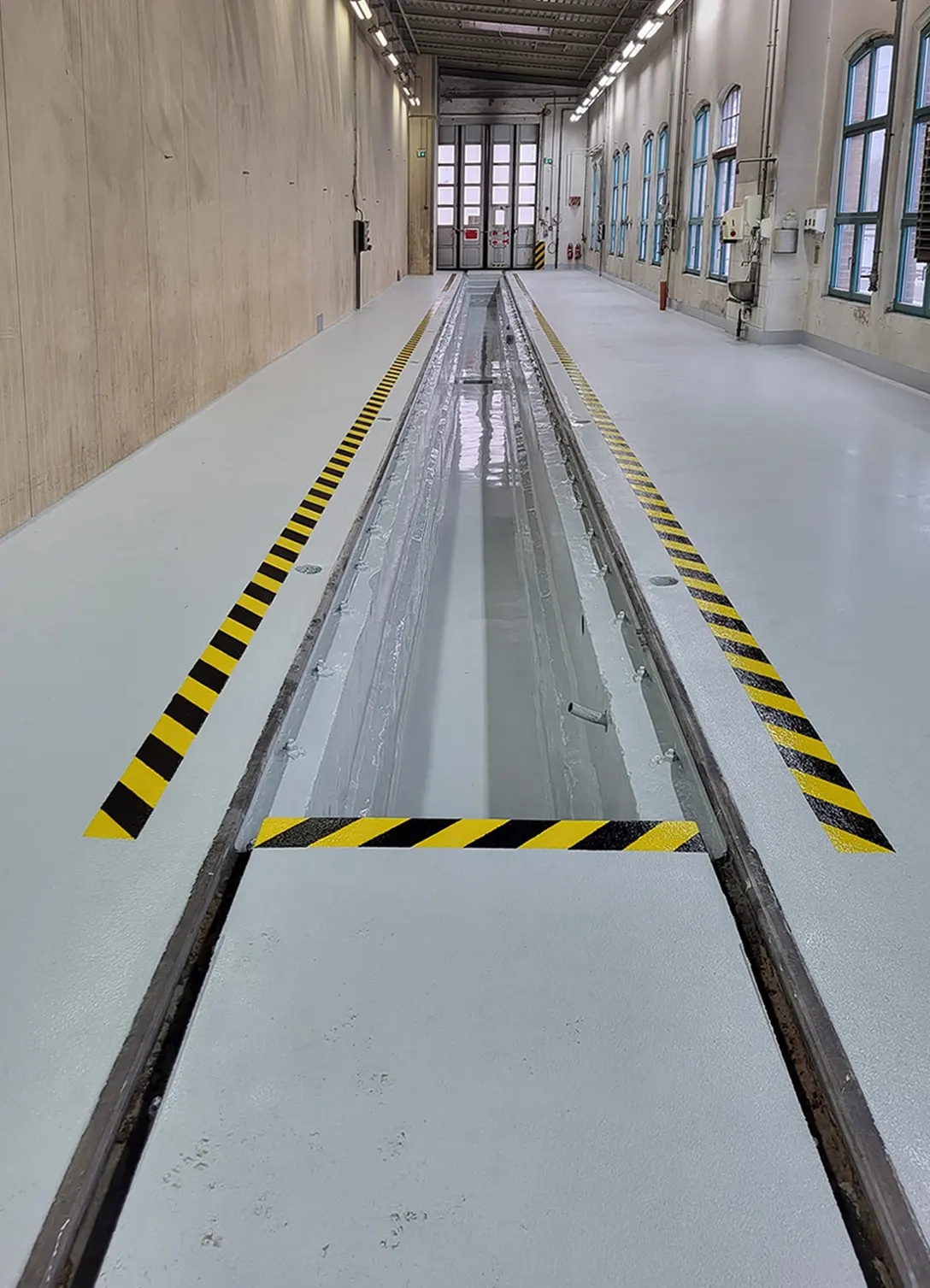
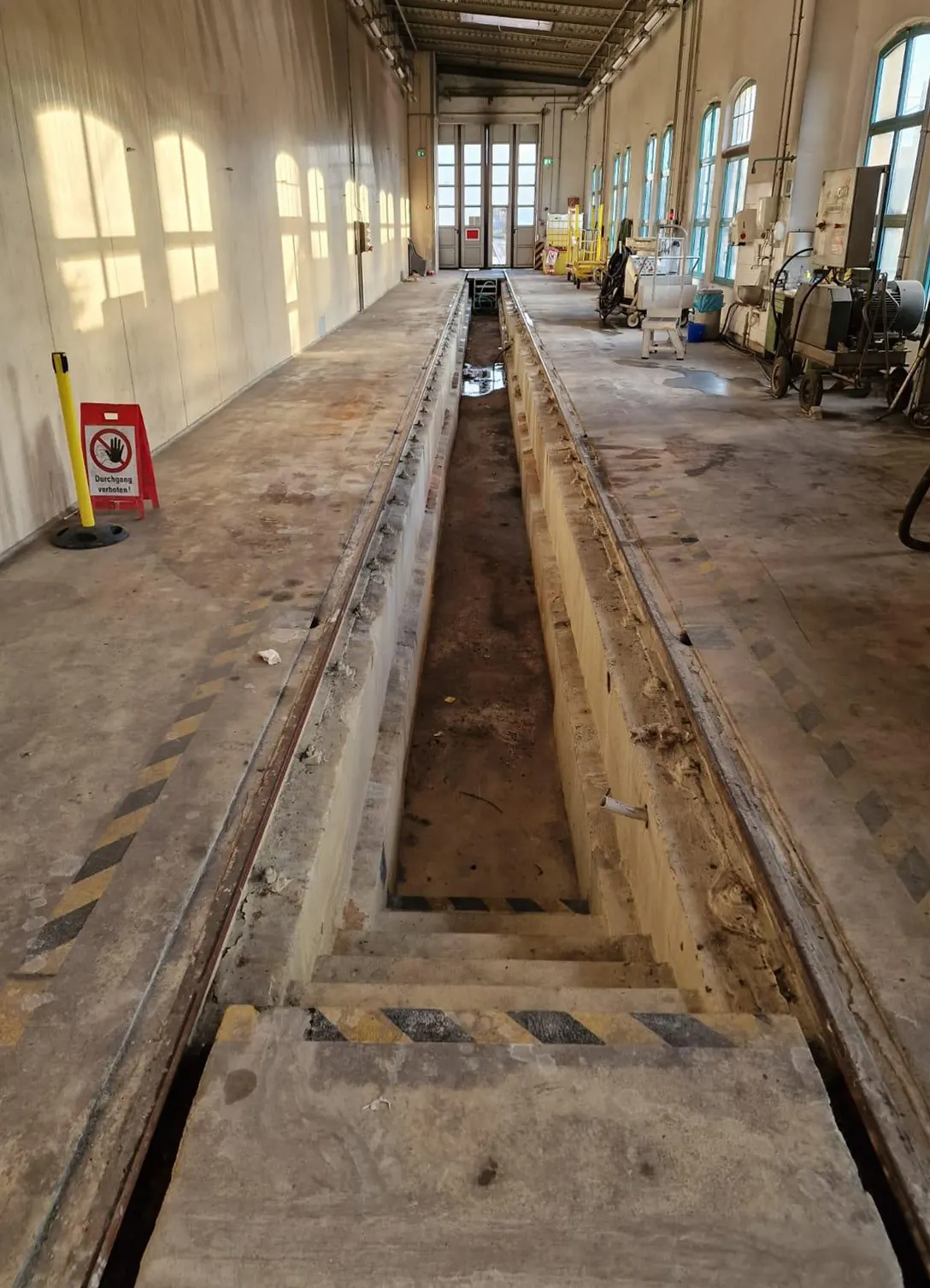
Where water-polluting substances are stored, filled, or used, the floor surface must function as a secondary barrier. A suitableWHG coating ensures the surface’s impermeability, durability, and operational integrity—including critical connections such as transitions, edges, and perimeter areas. The work is carried out as a retrofit to existing structures; new concrete or screed installations, as well as click-lock flooring, are not included in the scope of services.
Why Quantec?
Your Partner for Durable Industrial Floor Renovation
When it comes to WHG coatings, experience, expertise, and compliance with legal requirements are crucial. As a certified WHG specialist company, we have many years of experience in carrying out challenging projects and use only approved WHG coating systems. This ensures that you receive professional service in accordance with applicable requirements—reliable and from a single source.

Systems for WHG/AwSV Requirements
Coating structures that specifically provide sealing and durability.
Highly Detailed Design
Focus on connections, peripheral areas, and junctions—that's where most leakage risks occur.
Implementation Suitable for the Business
Work can be organized into designated sections.
In-House Staff & Equipment
End-to-end execution without outsourcing.
Why WHG Zones Have Special Requirements
In areas subject to the Water Resources Act (WHG), it is not only abrasion resistance that matters, but above all the combination of watertightness, chemical resistance, and sound design details. Weak points often occur at edges, inlets, baseboards, joints, and transitions between usable areas.
Typical triggers for corrective action
Typical triggers for corrective action
- Wear or damage to the surface caused by media, cleaning, or operation
- Cracks, spalling, or “soft” edge zones in containment and transfer areas
- Leaky connection details (transitions, wall connections, penetrations)
- Recurring minor repairs without a robust sealing surface design

WHG Coating as a Functional Sealing Surface in Existing Structures
Quantec appliesWHG coatings in such a way that the surface can reliably fulfill its barrier function in the intended application area while remaining easy to maintain during daily operation. This is based on a system design tailored to the media profile, usage, and cleaning regimen—supplemented by detailed training that minimizes leakage paths.
From Damage Assessment to a Stable Foundation

Assessment

Milling a surface

Repair Damaged Areas

Grinding

Leveling layer

WHG Coating

Sealing Layer

Completion
Services Related to WHG Coatings
Repair of Existing Structures as the Basis for the Sealing Surface
- Subgrade Assessment and Repair of Damaged Areas (Existing Structure)
- Remediation of Peripheral Areas and Transitions as Preliminary Work for Water Tightness
- Treatment of cracks and damaged areas in WHG-regulated zones (using appropriate methods)
Coating Systems with EP
- Designed as a sealing and protective system with defined durability
- Surface configuration tailored to the intended use (e.g., traction, cleaning)
- Optional additions such as a conductive version, if required
Detailed training (crucial for practical application)
- Joints and transitions (e.g., edge areas, edges, connection zones)
- Integration of joint areas into a functional overall design
- Mechanical protection at hotspots (as needed, e.g., transition edges)
Classification: LAU and HBV areas, media, and operational logic
Areas subject to the Water Resources Act (WHG) are typically part of facility areas where substances are stored, filled, or handled (LAU) or manufactured, treated, and used (HBV). This results in requirements for the sealing surface that cannot be met by “standard industrial floor coatings” alone.
Parameters That Determine System Selection
Media List
Substances, concentrations, temperature, exposure times
Usage
Traffic, point loads, shunting and handling operations
Cleaning
Chemistry, Interval, Mechanics (Brush, Pressure)
Detail Zones
Transitions, Edges, Peripheral Areas, Interpenetrations
Time window
Closure Times, Sub-Areas, Shift Operations
Documentation and traceability that ease the burden on operators
In WHG-regulated areas, it is essential that the condition, design, and system structure remain traceable. For this reason, projects are structured so that decisions (utilities, usage, detailed zones) are clearly incorporated into the design.
Typical content that you can use for your documentation
Typical content that you can use for your documentation
- Project-specific delineation of relevant areas and zones
- Description of the system structure and detailed design
- Guidelines for Use, Maintenance, and Inspection During Operation
- Provision of specific instructions regarding repair windows for future maintenance work

Typical Applications for WHG Coatings
Chemical Storage and Container Storage Areas
Filling and Transshipment Areas (IBCs, drums, containers)
Maintenance Areas with Oils/Operating Fluids
Production areas involved in the manufacturing process that use substances hazardous to water
Containment and drainage areas within plant sites
Work in designated sections instead of a full closure
WHG zones are often located within ongoing processes (filling, transshipment, production). Implementation can be organized so that affected areas are processed one after another and can be safely returned to use after inspection.
Practice Modules
Segmentation by operational routes and media hotspots
Defined transitions between developed and usable areas
Implementation during off-peak hours when process windows are tight
Clear safety and access control procedures for operators and staff
WHG Check (Media + Usage)
They will send the media list, operational data, and affected zones. The goal is to clearly define the requirements.
System Concept + Details
You will receive a structured solution for surface construction and specific details (transitions, edge zones, joint areas).
Completion and Handover
Implementation is carried out by our in-house team. You will then receive a well-organized handover for operations and internal documentation.
Before
Afterward

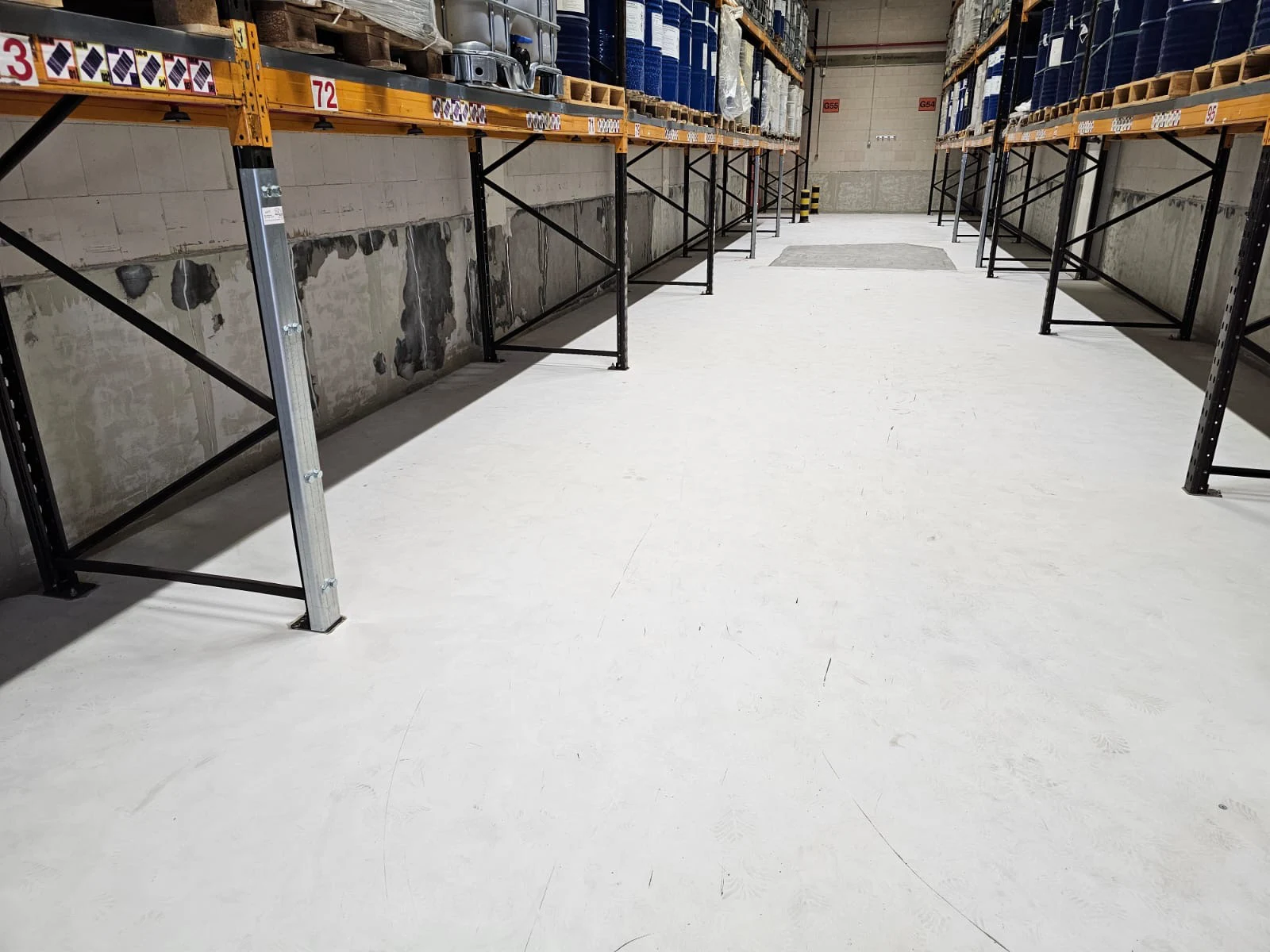
LAU/HBV Areas · Sealing Surface as a Secondary Barrier · Media Resistance · Traceable Design
Types and Varieties of WHG Coatings (Coatings in Accordance with WHG)
Conductive WHG Coating (ESD-WHG system) on concrete in LAU facilities
| Operating Principle | WHG sealing surface with integrated conductivity, if the system area has additional electrostatic requirements; the conductivity must remain stable throughout the service life. |
| Delimitation | Compared to non-conductive WHG systems, the ESD functional chain is added as an additional boundary condition (zone boundaries, wear zones, cleaning logic). |
| Typical Uses | Media Areas in ESD-Sensitive Manufacturing/Test Zones, Defined transfer zones with WHG and ESD requirements |
| Column | Typical industrial characteristics | Relevance to Interpretation |
|---|---|---|
| System type | WHG + Discharge Capacity (Approved) | Formal Suitability + Functional Requirements in a Single Structure |
| List of Media/Fluids | Based on approval (fluid groups) | Conductive ≠ automatically resistant to media |
| Derivative | dissipative, system-related | Functional stability depends on wear and maintenance |
| Wear/Traffic Profile | Depending on the system and usage, mostly low to medium; zoned | Abrasion affects the surface and electrical conductivity |
| Transitions | ESD ↔ Standard / WHG ↔ Standard | Transitions are critical in terms of both functionality and watertightness |
| Test/Verification Logic | related to licensing/monitoring | The audit trail may include time-based checks |
Chemical-Resistant WHG Coating by Liquid Group and Service Class
| Operating Principle | The system is selected based on permissible fluid groups and stress levels (e.g., low/medium/high) as well as operating mode (L/A/U); this determines the permissible range of application. |
| Delimitation | "Chemical resistance" is not a freely definable term here, but is based on approvals and media lists. |
| Typical Uses | Filling Zones, Maintenance Areas, Cleaning areas in LAU contexts with clearly defined media |
| Column | Typical industrial characteristics | Relevance to Interpretation |
|---|---|---|
| Media Logic | Liquid Categories + Individual Liquids | Determining System Approval |
| Operating mode | L / A / U | Affects exposure (e.g., drops, splashes, standing fluids) |
| Service Level | 1-3 (related to licensing) | controls permissible load groups |
| Temperature/Exposure Time | to evaluate on a company-by-company basis | can restrict sharing (depending on the system) |
| Cleaning Chemicals | process-dependent | must be compatible with the media profile |
| Entry Paths | Joints/Cracks/Connections | determine the risk of infiltration |
Joint Sealing Systems and Connection Details Within WHG Coatings
| Operating Principle | Joints, connections, and detail points are constructed using liquid-impermeable waterproofing systems that are suitable for the specific application in the LAU context; the waterproofing system is only as strong as its detail points. |
| Delimitation | Unlike “standard” joint sealing, suitability in the context of the WHG is determined based on intended use, regulatory requirements, and verification criteria. |
| Typical Uses | Connection to vertical structural members, Expansion joints in retention areas, Penetrations, Chute/Fitting Connections |
| Column | Typical industrial characteristics | Relevance to Interpretation |
|---|---|---|
| Detail Type | Expansion Joint / Edge Connection / Penetration | Most common leakage path/seal path during operation |
| Competency Framework | LAU-compliant waterproofing systems | must be suitable for its intended use |
| Motion Capture | depending on the details | determines the sealing concept and sidewall construction |
| Connection Geometry | Defined Throats/Transitions | reduces notch stresses and leakage paths |
| Testing/Documentation Requirement | Equipment Documentation/Operating Instructions | Operator Obligations and Record-Keeping in the Context of the AwSV |
Mechanically reinforced WHG sealing surface for wheel load and shear zones (top layer/spreading logic)
| Operating Principle | Additional mechanical strength is achieved through a system-compliant structural/top layer design to withstand abrasion and shear forces in high-traffic areas without compromising the sealing function. |
| Delimitation | Not every “non-slip surface” is automatically compliant with the WHG; the key factor is the approved system design, including the surface finish. |
| Typical Uses | Crossing Areas in Retention Areas, Transportation Corridors Within the WHG Zone, Gate/Ramp Lines with Media Risk |
| Column | Typical industrial characteristics | Relevance to Interpretation |
|---|---|---|
| Traffic Profile | Pallet Trucks/Forklifts, Changing Direction | Shear and impact loads predominate |
| Surface function | non-slip/textured | Safety vs. Cleanability in Media Zones |
| Poetry Reserve | About Layer Cross-Section/Top Layer | Mechanical wear must not cause the seal to fail. |
| Peripheral and Transitional Education | defined | Prevents edge chipping along the wheel load line |
| Maintainability | zonal reparability | Hotspots must be repairable without disrupting the system |
System-compliant penetrations and fasteners in surfaces with WHG Coating
| Operating Principle | Fastening/penetrations must be designed so that the sealing function is not “interrupted”; in approval-based systems, specific fastening systems may be tied to defined coating systems. |
| Delimitation | Standard fasteners without system-specific sealing are problematic in the context of the WHG-this is an issue of leak tightness and verification (system integration). |
| Typical Uses | Mounting points, Cable/Equipment Feet, Structures in Retention Areas, retrofit installations |
| Column | Typical industrial characteristics | Relevance to Interpretation |
|---|---|---|
| Specific risk | Localized perforation of the sealing surface | Primary failure mechanism in structural components |
| System Integration | Coating- and certification-related | The mounting may be linked to a specific WHG system |
| Seal Integrity Check | defined sealing section | Prevents infiltration along the fastener |
| Inspectability | Ability to view/monitor | The ability to detect leaks is an integral part of primary safety |
| Supporting Documents | related to registration/documentation | Filing in Plant Documentation in Accordance with AwSV |
WHG Coating System on Concrete in LAU Facilities (Non-Conductive)
| Operating Principle | A liquid-impermeable, chemically resistant coating serving as the primary barrier on existing concrete surfaces in retention structures; system composition consisting of a primer, a scratch coat (if necessary), and a topcoat. |
| Delimitation | It differs from “standard industrial floor coatings” in that it has a formally verified range of suitability (LAU, liquid groups/service classes) and is designed with meticulous attention to detail. |
| Typical Uses | Containment Rooms/Trays, Safety Zones in Indoor Areas, Designated zones for water-polluting substances |
| Column | Typical industrial characteristics | Relevance to Interpretation |
|---|---|---|
| Area of application | LAU (Storage/Filling/Transshipment) | Defines the permitted use in the context of the facility |
| Proof of Qualification | abZ/aBG (system-specific) | The system may only be used within the scope of its approval |
| Substrate | Existing Concrete Surfaces | Cross-Section, Adhesion, and Pore Distribution Determine Sealing Performance |
| Sealing function | liquid-impermeable (system-specific) | Core Function of Primary Safety |
| Chemical Resistance | Regarding Fluid Groups/Appendix 1 (related to certification) | The media list is a driver of interpretation |
| Dry film thickness | Typical for this system: approx. 1.3-2.2 mm | Affects density reserve and mechanical robustness |
| Detailed points | Connections/Joints/Transitions | Common leakage paths; to be addressed through design |
WHG Coating (Coatings in accordance with WHG/AwSV)
In a technical sense, a WHG coating is a certification of suitability and system compliance for coating or sealing systems used in facilities that handle water-polluting substances (including LAU: storage, filling, and transshipment).
The applicable design is not based on a “standard coating structure,” but rather on the facility’s operating mode, the stress level, liquid/medium groups, and specific details (joints, connections, penetrations). In Germany, the building code framework is addressed through the AwSV and associated suitability and verification procedures; corresponding coating and waterproofing systems are classified as construction products or construction types in the context of LAU facilities. (Laws on the Internet)
Quantec Industrieböden® GmbH implements WHG/AwSV-compliant sealing surfaces in existing facilities as a system service, focusing on functionally critical zones (edge connections, areas near joints, transitions) and documentation-compliant execution within operational time windows.

FAQ


Logistics & Warehousing
Manufacturing & Mechanical Engineering
Food & Hygiene
Cold Storage & Temperature Fluctuations
Chemistry/Media & WHG/AwSV
ESD & Special-Purpose Functional Surfaces
Request a WHG Coating Quote—Including a Thorough Review of the System and Details
Please send us the media list, area data, and time frame. You will receive a structured assessment of the requirements and their implementation in the existing system.
The content of this page is intended to provide general information about WHG Coating and does not constitute project-specific technical planning or a guarantee of specific properties. Since specific requirements and results depend on individual on-site conditions, no liability is assumed for the accuracy of this information.


INDUSTRIEBÖDEN ® GmbH

Your symptoms
The Quantec Solution
We will be happy to contact you.
Would you like a personal telephone consultation?