


You are here:
Renovating Structural Expansion Joints - Safely Accommodating Movement
Quantec Industrieböden® GmbH renovates structural expansion joints in industrial, logistics, and commercial buildings—with a focus on effective movement absorption, stable joint flanks, and cleanly finished transitions into traffic areas.


Building expansion joints structurally separate parts of a building—during operation, they become critical transition points when joint edges break away, height differences develop, or the sealing function deteriorates. Professional rehabilitation stabilizes the joint edges, reduces impact stress, and prevents consequential damage along traffic routes. The work is carried out as in-place repair and can often be planned in sections.
Why Quantec?
10-Year Warranty
We don’t see ourselves as merely a service provider, but as a reliable partner by your side. For us, quality isn’t just a promise—it’s a commitment: That’s why we offer a 10-year warranty on damage repairs and on our expansion joints—for long-lasting solutions you can count on.

Function Over Form
Motion capture and transitions are reproduced with technical accuracy.
Stabilize Edge Zones
Reduces edge damage in traffic lanes and crossings.
Scheduled Releases
Division into subareas based on traffic patterns.
In-house production using our machinery
End-to-end execution without outsourcing.
What Distinguishes Structural Separation Joints from “Normal” Movement or Expansion Joints
Building expansion joints are structural separation points between building components. They must accommodate movement without transferring forces to adjacent floor surfaces. If joint flanks are damaged or transitions are not constructed stably, impact loads and damage to peripheral areas occur, which extend along traffic routes.
Typical damage patterns
Typical damage patterns
- Chipped joint edges and “soft” or structurally weak edge zones
- Height misalignment with impact stress when vehicles pass over
- Cracks in the immediate vicinity of the expansion joint
- Unstable transitions in gate, ramp, or lane areas
- Recurring repairs without addressing the movement components

Expansion Joint Rehabilitation as a Transition and Movement Solution
Quantec rehabilitates structural expansion joints in such a way that movements are absorbed in a controlled manner and traffic areas remain stable and passable. Key factors include load-bearing joint flanks, a suitable transitional solution, and the integration of the edge zones into the existing surface.
From Damage Assessment to a Stable Foundation

Assessment

Mill out the joint area

Prepare the surface

Joint Rebuilt
Services Related to Building Expansion Joints
Repair of Joint Flanks and Edge Areas
- Restoration of load-bearing joint flanks in existing structures
- Stabilization of damaged edge zones in traffic areas
- Repair of spalled areas along the expansion joint
Transitions and Passability
- Transition Solutions for Forklift and Pallet Jack Traffic
- Minimizing impact stress through clearly defined transitions
- Integration into traffic routes and lanes without creating new edge hazards
Interfaces to Additional Services
- Combination with crack repair when crack edges extend into the surrounding area
- Integration into industrial floor restoration for extensive damage in the surrounding area
- Mechanical protection using heavy-duty profiles or special joint systems when impact loads occur regularly
Which Factors Determine the Renovation
When it comes to expansion joints, defining the correct objectives is crucial: Movement must remain possible, while at the same time, the joint must be safe for vehicles to cross.
Relevant Parameters
Location
Traffic corridor, ramp/gate area, traffic lane, transition between hall zones
Usage
Frequency of vehicle traffic, forklift traffic, point loads, maneuvering
Proportion of physical activity
Structural relative movement between building components
Geometry
Joint width, vertical misalignment, condition of the joint flanks
Environment
adjacent edge areas, cracks, older repair sites
Time window
Blocked Hours, Section Release, Off-Peak Hours
Repair Expansion Joints Using Traffic Management Strategies Instead of Full Road Closures
Expansion joints often run perpendicular to main traffic routes. For this reason, the project is organized so that transitions are managed in a controlled manner and road openings are scheduled realistically. Rehabilitation using special quick-drying materials is possible, ensuring that major traffic routes remain closed for only a few hours.
Key Elements of Implementation
Key Elements of Implementation
- Zoning by traffic routes and crossings
- Defined transitions during the work
- Off-peak scheduling for heavily trafficked areas
- Reopening by section so that paths can be used again quickly
Typical situations in which expansion joints are repaired
An expansion joint crosses a main traffic lane and causes impact loads
Recurring cracks along the same joint edges
The height difference is increasing, leading to a "bumpy" ride
Cracking Around the Construction Joint Despite Repairs
Transitions in gate/ramp areas with high traffic volume
Functional Test
The location, usage, nature of the damage, and evidence of movement are documented.
Goal Setting: Transition + Movement
You will receive a clear recommendation on how to technically combine movement absorption and passability.
Repair and Interim Training
Joint flanks, edge zones, and transitions are stabilized in the existing structure.
Approval and Operating Instructions
Phased approval and instructions for use/inspection during operation.
Before
Afterward
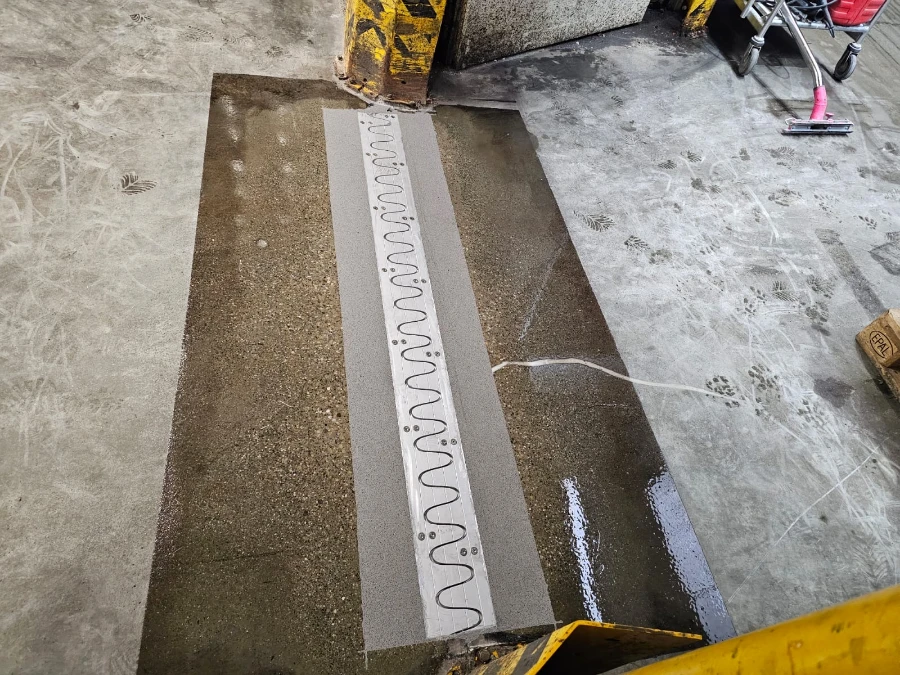
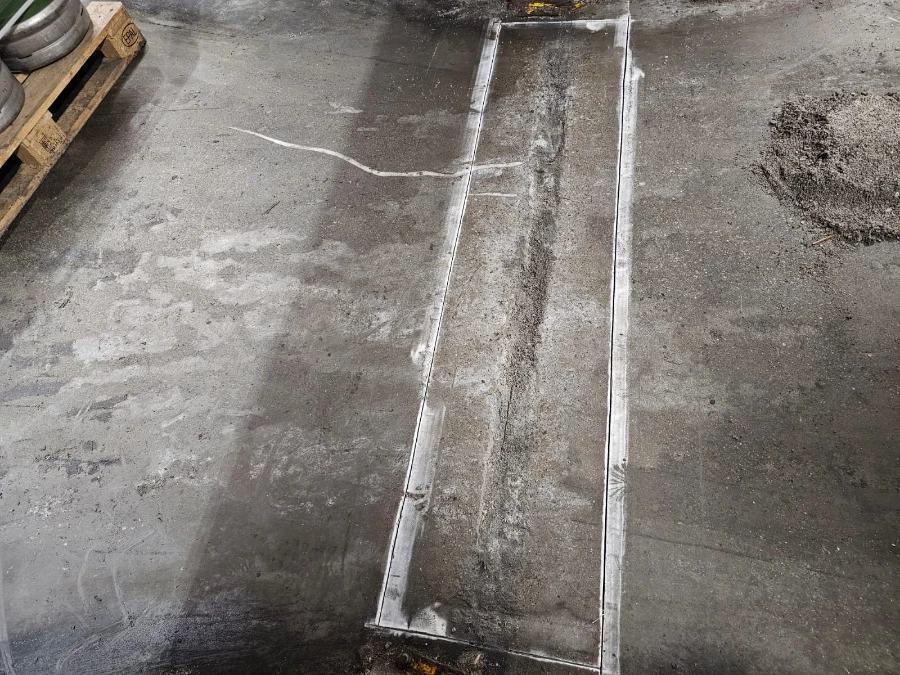
Building expansion joints · Drive-over capability · Transitions · Stable joint flanks · Predictable curing time
Types and Varieties of Structural Expansion Joints
Construction Joints for exterior and gate areas (weather, water, dirt ingress)
| Application Logic | In outdoor or areas near doors, water ingress, dirt, and temperature fluctuations are the primary concerns; the joint design must balance drainage, watertightness, and traffic resistance. |
| Delimitation | Interior solutions without entry management often result in dirt buildup, jamming, and damage from edges on the exterior. |
| Typical Uses | Industrial Doors, Ramp Lines, Outdoor Service, Transition Between Indoors and Outdoors |
Construction Joints as full-width expansion joints (movement-accommodating separation point created by the floor structure)
| Application Logic | Separation of two structural sections when movements must not be transmitted to adjacent structural elements. The surface must be designed so that no damage chain resulting from edge-to-edge contact occurs. |
| Delimitation | No dummy joint/contraction joint, The separation point is designed as a structural joint that allows for permanent movement. |
| Typical Uses | Joints between building sections, Transitions Between Old and New Buildings (Existing Structures), Areas subject to relative movement caused by settlement or temperature changes |
Construction Joints with fire protection requirements (joint area as a functional interface)
| Application Logic | If the expansion joint also serves a fire protection function within the building’s design, the joint cavity must be filled with suitable barriers or inserts; the cover or bridging solution must remain compatible with this. |
| Delimitation | Complements the mechanical/sealing function with a structural protective function, Attention to detail is crucial |
| Typical Uses | Separation points between fire compartments, Technical Zones, Areas Requiring Partitioning |
Construction Joints with elastomeric sealing tape (strip/gland seal principle)
| Application Logic | If the primary concern is sealing against ingress (dust/liquid) and the surface does not necessarily require broad coverage, an elastomeric seal is installed in the joint. |
| Delimitation | High wheel loads without additional sidewall reinforcement increase the risk of sidewall damage, The gasket alone does not provide edge reinforcement. |
| Typical Uses | Technical and Auxiliary Areas, Areas with specific sealing requirements and moderate traffic |
Construction Joints with sliding-plate cover (sliding-plate principle)
| Application Logic | When longitudinal movement is predominant, a plate structure is used that slides in a controlled manner and keeps the passageway closed. |
| Delimitation | Not suitable when three-dimensional movements are significant or when debris regularly blocks the sliding surface. |
| Typical Uses | Straight joints in hallways/traffic corridors with a defined direction of movement. |
Chemical-Resistant Construction Joints in Accordance with WHG (Areas Exposed to Media, Focus on Sealing Path)
| Application Logic | When there is media contact (cleaning chemicals, oils, process media), the sealing solution must be selected based on the medium, concentration, temperature, and exposure time; the joint is treated as the entry path. Especially in areas that comply with t |
| Delimitation | Chemical resistance always depends on the specific medium, A standard gasket is not necessarily suitable |
| Typical Uses | Maintenance/Service Areas, Filling/Cleaning Zones, Transportation routes related to the media industry |
Modular Construction Joint (Multi-Part/Center Beam System for Large Movements)
| Application Logic | When movement ranges are large and the need for vehicle passability remains a requirement, multi-section designs based on the beam/lamella principle may be considered. |
| Delimitation | Greater structural complexity than cover plates, but better motion tracking across multiple axes |
| Typical Uses | Joints with a larger opening, Areas with Differences in Settlement, Transitions with Expected Movement Components |
Retrofitting/Renovation of Construction Joints in Existing Structures (Milling, Reprofiling, Integrating the System)
| Application Logic | If the construction joint causes operational problems (chipped edges, misalignment, debris ingress), it is repaired in the existing structure during defined maintenance windows and retrofitted with profile and sealing systems. |
| Delimitation | No new joint construction, The focus is on edge zone load-bearing capacity, geometry, and compatible system integration |
| Typical Uses | Ongoing Operations, Night/Weekend Window, prioritized transportation corridors |
Drivable Construction Joint with a flush, heavy-duty cover (flush, wheel-load-dominant)
| Application Logic | If forklifts or pallet jacks regularly cross the joint, the surface should be designed with a flush cover so that wheel loads do not strike the unprotected sides of the joint. |
| Delimitation | The focus is on wheel load durability, Motion is absorbed through defined bearing/sliding areas of the system |
| Typical Uses | Logistics Corridors, Intersection Areas, Goal lines in high-traffic indoor facilities |
Construction Joints
Building expansion joints are continuous joints between sections of a structure that accommodate relative movements caused by thermal expansion, settlement, and, where applicable, vibrations, without allowing loads to be transferred uncontrollably to the peripheral areas. In industrial flooring applications, the technical challenge usually arises at the surface: trafficability, edge stability, sealing integrity, and defined transitions determine functionality and maintenance requirements.
In logistics and production, wheel loads and shear forces repeatedly act on the joint edges; as a result, cover and profile systems, as well as integration into the existing structure, are critical design factors.
Quantec Industrieböden® GmbH implements structural separation joints in existing structures as a system solution, typically with side-flange reprofiling and integration using EP-, AC(PMMA)-, or PU-based mortar/sealing systems within zoned operational windows.

FAQ


Logistics & Warehousing
Manufacturing & Mechanical Engineering
Food & Hygiene
Cold Storage & Temperature Fluctuations
Chemistry/Media & WHG/AwSV
ESD & Special-Purpose Functional Surfaces
Repairing Building Expansion Joints—With Sturdy Transitions
Please send us details on the location, usage, and extent of the damage. You will receive a structured assessment regarding functional restoration and section planning.
The content of this page is intended to provide general information about Construction Joints and does not constitute project-specific technical planning or a guarantee of specific properties. Since specific requirements and results depend on individual on-site conditions, no liability is assumed for the accuracy of this information.


INDUSTRIEBÖDEN ® GmbH

Your symptoms
The Quantec Solution
We will be happy to contact you.
Would you like a personal telephone consultation?