


You are here:
Installing Heavy-Duty Profiles - Providing Long-Lasting Protection for Edges and Transitions
Quantec Industrieböden® GmbH installs heavy-duty profiles in industrial, logistics, and commercial spaces—as mechanical edge protection for high-traffic transitions, traffic lanes, and crossings subject to recurring peak loads.
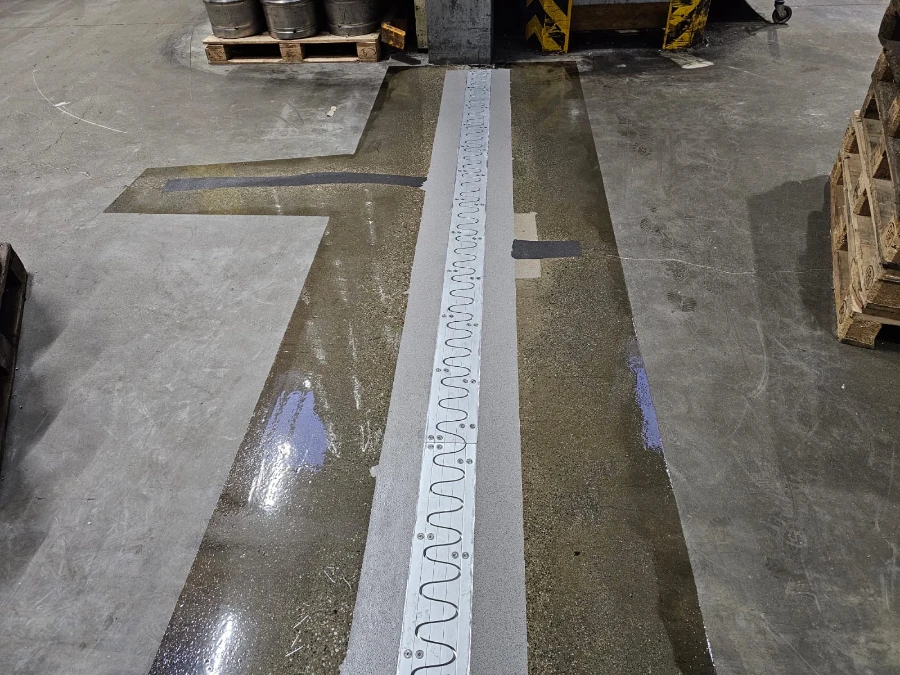

Much of the secondary damage does not occur across the surface but rather at the edges: transitions are driven over, edge areas break away, and repairs become a recurring issue. Heavy-duty profiles provide mechanical protection for these hotspots, improve drive-over stability, and reduce breakage along traffic routes. Installation can be carried out in sections and can be combined with joint work or rehabilitation projects.
Why Quantec?
10-Year Warranty
We don’t see ourselves as merely a service provider, but as a reliable partner by your side. For us, quality isn’t just a promise—it’s a commitment: That’s why we offer a 10-year warranty on damage repairs and on our expansion joints—for long-lasting solutions you can count on.

Mechanical Protection Instead of Repeated Repairs
Heavy-duty profiles protect edges in areas where peak loads regularly act on the edge.
Can be planned during ongoing operations
Phased implementation with defined approval.
Interface Competence
Can be combined with expansion joint, crack, and joint repair.
100% in-house work
Our own machinery—no subcontractors.
Why Edges and Transitions Are the Most Common Weak Points
Edges are constantly subjected to stress during operation: roller loads encounter height differences, shear forces act during maneuvering, and impacts are concentrated within a few centimeters of the edge. Without mechanical protection, spalling occurs, which spreads along the travel path and causes the surface to become increasingly uneven.
Typical conditions where heavy-duty profiles are cost-effective
Typical conditions where heavy-duty profiles are cost-effective
- Recurring edge spalling at transitions and crossings
- Gate areas and structural expansion joints can be equipped with heavy-duty profiles
- Spalling in traffic lanes near ramps, gates, or parking areas
- Impact stress caused by height misalignment (“rattling”)
- Edge damage in the vicinity of joints or separating transitions
- Repeated minor repairs to the same edge

Heavy-duty profiles to specifically relieve stress on the edge areas
Heavy-duty profiles provide mechanical protection at transitions and reduce the loads concentrated on a vulnerable edge. This keeps the crossings stable, relieves stress on the edges, and extends the intervals between maintenance.
From Damage Assessment to a Stable Foundation

Assessment

Expose the installation area

Align Profile

Profile installed
Services Related to Heavy-Duty Profiles
Profile Installation in Hotspots
- Installation of heavy-duty profiles at transitions, crossings, and edges
- Stabilization of ramp and gate areas subject to high impact loads
- Integration into traffic lanes and logistics routes where peak loads occur regularly
Subgrade and Shoulder Repairs
- Preparation and Repair of Damaged Edge Areas in Existing Structures
- Treatment of spalling and damaged areas around the profile
- Creation of a stable connection to the existing surface
Interfaces with Joints, Cracks, and Coating Systems
- Incorporation into expansion joint repair when transitions are close to the joint
- Combination with crack repair to stabilize the surrounding area
- Connection to EP/AC/PU systems for surface stabilization
Selection Criteria: Load, Geometry, Traffic
Not every profile is suitable for every hotspot. The key factors are the load acting on the transition and the pattern of traffic flow.
Relevant Parameters (Selection)
Traffic
Forklifts, pallet jacks, maneuvering, frequency of passage
Load Profile
Point load, impact load, shear forces at the interface
Geometry
Edge position, transition height, approach angle, adjacent edge zone
Environment
Proximity to joints, ramps, gates, and parking spaces
Time window
Blocked Hours, Section Release, Off-Peak Hours
Installing heavy-duty profiles without disrupting logistics
Profile sections are usually localized and can be implemented in stages along the traffic route. This allows central pathways to remain usable while critical crossings are stabilized one after another.
Typical Organization
Typical Organization
- Zoning by ramps, gates, crossings, and parking lot axes
- Defined crossings during the work
- Implementation during off-peak hours in high-traffic areas
- Approval on a section-by-section basis with clear safety protocols
From Damage Assessment to a Stable Foundation

Document the damage

Prepare the joint area

Joint repaired

Joint repaired
Where Heavy-Duty Profiles Are Particularly Useful
Ramp and gate areas subject to impact loads
Transitions between usable areas and traffic routes
Lanes with recurring damage along the edges
Areas surrounding parking spaces (e.g., transshipment/logistics areas)
Transitions near joints where the edge areas regularly break off
Fewer breakouts thanks to stable edge guidance
Recurring damage often occurs because edges are forced to bear the load continuously without mechanical protection. Profiles relieve stress on the edge area and ensure defined drive-over capacity—which is crucial for logistics and production processes.
Quality Factors in Operations
A solid connection to the existing space
Specified drive-over capacity without impact stress
Effective combination with joint and crack repair measures
Section-by-section approval based on a clear construction site logic
Heavy-Duty Profile Check (Hotspot + Usage)
Please send photos/sketches, the current situation, and how the space is used. The goal is to prioritize: which edges are causing consequential damage.
Solution for Geometry and the Boundary Region
You will receive a recommendation on whether heavy-duty profiles, edge zone repair, or a combination with joint/crack repair is appropriate—including section logic.
DIY Installation + Approval
The work is carried out by our own team using our own equipment. Once completed, the crossings are stable enough to drive over and are safe for use.
Before
Afterward
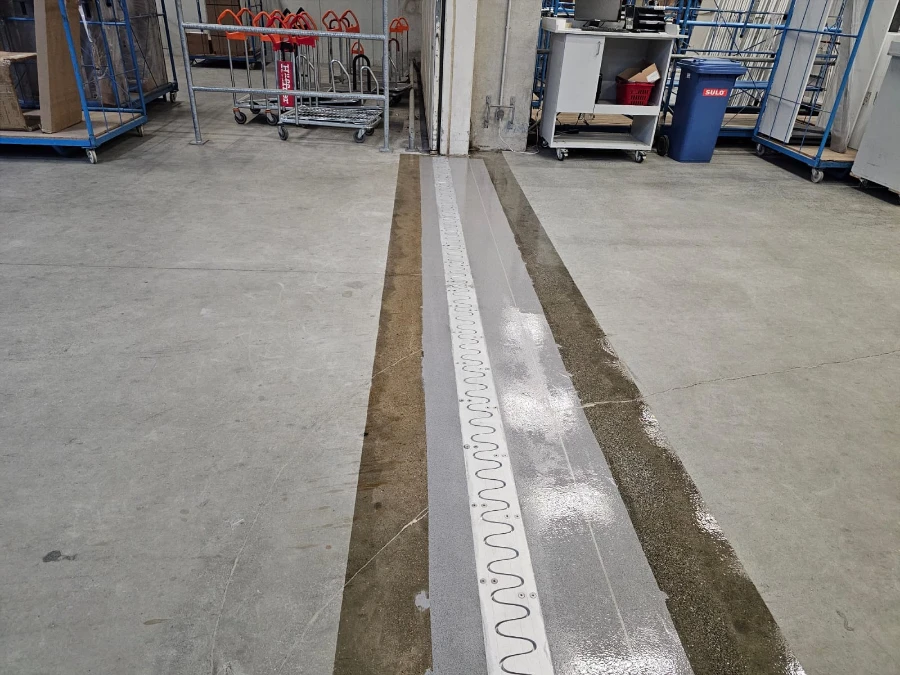

Manufacturing | Logistics | Commercial · Edge protection · Stabilizing transitions · Fewer broken edges
Installation Using PMMA Mortars
Heavy-duty stainless steel profiles for corrosive or wet-cleaned areas
| Operating Principle | Profile function as with steel, but with higher corrosion resistance; advisable, if there is moisture, Cleaning chemicals or process media that limit the service life of unalloyed steel. |
| Delimitation | The mechanics remain similar, The driving factor is the environment (corrosion/chemical exposure), not just the wheel load level. |
| Typical industrial applications | Wet Cleaning, media-related fields, Transitions with recurring moisture ingress |
| Auslegungsparameter | Industrietypischer Bereich | Entscheidungsrelevanz |
|---|---|---|
| Werkstoff (typisch) | 1.4301 / 1.4404 | Korrosionsniveau und Reinigungschemie |
| Profilstärke | 5-12 mm | Verschleißreserve trotz Korrosionsschutz |
| Medien-/Reinigungsprofil | Reiniger/Feuchte/Temperatur | maßgeblich für Werkstoffwahl |
| Oberfläche | gebeizt/geschliffen | Reinigbarkeit und Anhaftung |
| Einbindungsmaterial | EP/PU per zone | Systemkompatibilität im Bestand |
| galvanische Paarung | beachten | Kontaktkorrosion bei Mischmetallen |
| Detailanschlüsse | dicht/staubarm | Eintrittspfade minimieren |
| Wartungsintervall | reduziert (Ziel) | Instandhaltungsplanung im Betrieb |
Heavy-duty profiles (Installation with PMMA mortar during short downtime periods)
| Operating Principle | Profile retrofitting is performed using fast-setting mortar systems, so that crossing zones can be used again within tight time frames. |
| Delimitation | This is not a separate profile family, but rather an implementation variant (approval engineering) for time-critical areas. |
| Typical industrial applications | Night/Weekend Window, Goal Lines, Bottlenecks, High-frequency forklift axles |
| Design Parameters | Industry-specific field | Decision relevance |
|---|---|---|
| Time window | 3-8 hours | determines the choice of system and process |
| Mortar System | PMMA | Quick approval for pedestrian and vehicle access |
| Profile size | small to large | Installation/Curing Logic by Cross-Section |
| Section length | 2-10 m per cycle | Traffic Management During Implementation |
| Transitional Training | chamfered/flush | immediate response to being run over |
| Wheel load capacity | step by step | Access by Usage Level |
| Substrate Preparation | mandatory | Composite Structure and Breakaway Safety |
| Temperature/Ventilation Logic | relevant | Response Procedures and Operational Organization |
Heavy-duty edge protection profiles for panel edges, steps, and entry areas
| Operating Principle | Metal edge reinforcement on exposed edges or height changes; reduces spalling caused by impact and shear stresses (collision, Shunting). |
| Delimitation | Not joint-related, but rather edge-oriented; it is frequently used there, where the load does not pass “over a joint”, but is introduced over an edge. |
| Typical industrial applications | Platform edges, Pit Edges, Road Markings, Entry/Approach Edges |
| Auslegungsparameter | Industrietypischer Bereich | Entscheidungsrelevanz |
|---|---|---|
| Profiltyp | L-/U-/Sonderprofil | Schutzwirkung abhängig von Kantenabdeckung |
| Profilstärke | 5-12 mm | Stoßrobustheit bei Anfahrereignissen |
| Kantenüberstand | 0-3 mm (Ziel: bündig) | Vermeidung von „Hakenkante“ |
| Einbindetiefe | 25-70 mm | Ausreißfestigkeit im Bestand |
| Stoß-/Anfahrenergie | niedrig-hoch | Profilquerschnitt und Verankerung |
| Untergrundzustand | intakt bis ausgebrochen | Vorprofilierung mit Harzmörtel nötig |
| Einbindungsmaterial | EP Mortar | Haftung, Freigabezeit, Schubtragfähigkeit |
| Korrosionsumfeld | trocken bis nass | Materialwahl (Stahl vs. Edelstahl) |
Heavy-duty frame profiles for recesses (shafts, channels, built-in components)
| Operating Principle | The frame profile encloses an opening or built-in component and stabilizes the edge area against wheel loads; it serves as a defined load-bearing and connection area. |
| Delimitation | Unlike edge protection on “open” edges, the all-around edging is crucial here, often with tight tolerances for lids and internal components. |
| Typical industrial applications | Cable/Drainage Channels, Manhole Covers, Inspection openings, Components Installed in Traffic Areas |
| Design Parameters | Industry-specific field | Decision relevance |
|---|---|---|
| Frame Shape | closed / segmented | Assembly and Tolerance Concept |
| Frame width | 40-120 mm | Load transfer around the opening |
| Profile Thickness | 6-15 mm | Edge Stability Under Wheel Load |
| Tolerance on the installed part | 1-5 mm | Prevent rattling/knocking |
| Load Pool | Pallet Trucks to Forklifts | Frame Sizing and Integration |
| Connection Zone | Resin mortar bed / grout | Composite Structure and Breakaway Safety |
| Surface finish | flush / chamfered | Traffic Resistance and Ease of Cleaning |
| Maintenance/Cover Replacement | intended | Dismantlability without disrupting the system |
Heavy-Duty Threshold and Door Line Profiles (Indoor/Outdoor Transition, Drive-Over Edge)
| Typical industrial applications | Goal Areas, Delivery, Access Roads in Warehouses, Areas with frequent changes in direction |
| Delimitation | Focus on transition geometry and shock absorption; often combined with localized repair of existing structures, because goal lines are subject to heavy structural stress. |
| Operating Principle | Contoured transition in the area of gates, Roller door lines or exterior/interior transitions; reduces edge impact and protects the joint from damage caused by repeated passage. |
| Design Parameters | Industry-specific field | Decision relevance |
|---|---|---|
| Profile Geometry | Threshold/Ramp/Curb | Ride Comfort and Impact Load |
| Elevation Offset (Existing) | 0-10 mm | Need for Profiling/Alignment |
| Passing Speed | low-medium | Impact Energy and Tread Edge Load |
| Wheel Type | Solid Rubber / PU / Pneumatic | Effect on Edge Impact and Abrasion |
| Water/Dirt Infiltration | possible | Material and Connection Training |
| Binding length per side | 50-150 mm | Load Distribution in the Existing Structure |
| Binding material | AC(MMA) for short windows / EP for longer ones | Enable and Robustness Logic |
| Target Level | flush to slightly chamfered | Reduces edge impact during entry |
Heavy-duty profiles for building joints (movable drive-over profiles)
| Operating Principle | The profile/covering structure bridges a structurally active joint and allows for relative movement while maintaining a surface that can be driven over (sliding support/multi-part assembly, depending on the system). |
| Delimitation | Unlike expansion joint profiles, the primary focus here is on accommodating movement; however, the edges must still be designed to allow vehicles to drive over them. |
| Typical industrial applications | Expansion joints between construction sections, Warehouse Joints in Logistics, Transitions Due to Settlement and Temperature Differences |
| Design Parameters | Industry-specific field | Decision relevance |
|---|---|---|
| Direction of Movement | 1-3 axes | Profile/Sliding Principle and Connection Details |
| Path of motion (typical) | ±5-25 mm | Selection of Profile Design |
| Drive-over width | 80-250 mm | Wheel contact patch and contact width |
| Edge Armor | integrated / on the side | Edge Stability Under Impact Loads |
| Sealing Requirement | dust-resistant to airtight | Detailed Analysis of the Sealing Paths |
| Wheel Load Level | 10-60 kN per wheel (depending on the project or site) | Deck/Support Design |
| Integration into the Existing System | mechanical + mortar bed | Resistance to pull-out under shear forces |
| Maintenance access | required / optional | Inspection of Active Systems |
Heavy-duty profiles for joint reinforcement (reinforced joint/joint flange profiles) in forklift axles
| Operating Principle | Steel reinforcement on both sides along a through joint; the profiled edges absorb impact and shear forces and protect the joint flanks from spalling. |
| Delimitation | Unlike pure joint fillers, the load-bearing effect is edge-mechanical; compared to cover profiles, resistance to vehicle traffic takes precedence over movement coverage. |
| Typical industrial applications | High-Frequency Lanes, Intersection Areas, Gate zones subject to repeated wheel loads |
| Auslegungsparameter | Industrietypischer Bereich | Entscheidungsrelevanz |
|---|---|---|
| Profilform | Winkel-/T-Profil, beidseitig | Kantenstoß wird über Profilkante aufgenommen |
| Stahlqualität (typisch) | S235-S355 | Verformungs- und Verschleißreserve |
| Profilstärke | 10-15 mm | Lebensdauer bei Stoß und Schub |
| Steghöhe / Einbindetiefe | 30-80 mm | Verbundzone und Ausreißsicherheit |
| Fugenöffnung (Betrieb) | 10-60 mm | Geometrie der Überfahrzone |
| Radlastniveau (typisch) | 20-80 kN je Rad | Profil- und Einbindungsdimensionierung |
| Einbindungsmaterial | EP or AC (MMA) mortar | Lastübertragung in den Bestand, Freigabezeit |
| Ziel für Überfahrversatz | möglichst gering ≤ 1-2 mm | Stoßenergie und Geräuschentwicklung |
Heavy-duty profiles
Heavy-duty profiles are metal edge and joint reinforcements used in industrial, logistics, and commercial floors to stabilize the impact zone at crossings and reduce height differences or edge breakage in high-load areas. In existing structures, the design is primarily determined by the wheel load level, shear stress (curves/intersections), joint type (contraction/construction joint), and the geometry of the drive-over cross-section. Typical application points include forklift aisles, doorways, ramps, recesses (shafts/channels), and joints with recurring edge impacts. Quantec Industrieböden® GmbH integrates heavy-duty profiles into renovation and repair projects and embeds them into existing floors using EP-, AC(MMA)-, or PU-based mortar systems (no new concrete or screed installation, no click-lock flooring).

FAQ


Logistics & Warehousing
Manufacturing & Mechanical Engineering
Food & Hygiene
Cold Storage & Temperature Fluctuations
Chemicals/Media, WHG/AwSV, ESD & Special-Purpose Functional Surfaces
Installing Heavy-Duty Profiles - Stabilizing Transitions in a Predictable Manner
Please send us information on hotspots, usage, and time slots. You will receive a structured assessment of your profile strategy and its implementation in your business.
The content of this page is intended to provide general information about Heavy-duty profiles and does not constitute project-specific technical planning or a guarantee of specific properties. Since specific requirements and results depend on individual on-site conditions, no liability is assumed for the accuracy of this information.


INDUSTRIEBÖDEN ® GmbH

Your symptoms
The Quantec Solution
We will be happy to contact you.
Would you like a personal telephone consultation?