


You are here:
Epoxy Resin Coating - Durable Wear Layers for High-Traffic Surfaces
Quantec Industrieböden® GmbH installs epoxy resin (EP) coatings on existing industrial, logistics, and commercial floors—designed to withstand abrasion, traffic, and high mechanical stress, with robust detailing at transitions and edge areas.

Epoxy resin systems are particularly well-suited for applications where floors must withstand rolling loads, point loads, and heavy use on a long-term basis. The key factor is not just the resin, but the system’s structure within the existing structure: load-bearing edge zones, clean transitions, and a surface suitable for cleaning and operation. Quantec applies coatings as a repair solution for existing surfaces; it does not perform new concrete or screed installations or install click-lock flooring.
Why Quantec?
Your Partner for Durable Industrial Floor Renovation
We don’t see ourselves as merely a service provider, but as a reliable partner at your side. Every renovation is carefully and precisely planned, executed using high-quality materials, and designed for long-term use. This results in cost-effective and durable solutions for your industrial floor.

Focus on Mechanical Strength
EP systems for abrasion, traffic, and point-load zones.
Stable Peripheral Zones & Transitions
Reduces breakouts along edges and hotspots.
Phased Implementation
Approvals aligned with traffic patterns and shift operations.
100% in-house work
Our own machinery—no subcontractors.
When mechanical stress is the dominant factor
In many facilities, the main concerns are not chemicals or ESD, but rather abrasion, impact loads, and heavy traffic. Traffic lanes become rough, edge areas break away, and transitions become uneven. An epoxy resin coating forms a stable wear layer and reduces wear when the substrate is properly prepared and details are finished cleanly.
Typical indications for use
Typical indications for use
- High forklift and pallet jack traffic with clearly defined traffic lanes
- Areas subject to high point loads, e.g., aisleways between racks, walkways, and loading areas
- Recurring spalling at edges, joints, and perimeter areas
- Dusty surfaces due to abrasion and material handling
- Renovation of existing floors with a focus on a durable wear layer

EP Coating as a System—Not Just a “Coat of Paint”
Quantec implements epoxy resin coatings as a comprehensive system: preparatory work on existing surfaces, load-bearing edge zones, defined transitions, and a wear layer suited to the expected stress. This ensures the surface can withstand long-term stress, in line with its intended use.
Epoxy resin coatings typically consist of 2- or 3-component epoxy resin systems, which are applied as a primer, wear layer, and, if necessary, a sealer, depending on the intended use. This results in a seamless, abrasion-resistant, and durable floor coating that can be designed to withstand high mechanical stress, tire tracks, and point loads.
At the same time, epoxy systems offer excellent resistance to water, many cleaning agents, alkalis, diluted acids, and mineral oils. Depending on the requirements, smooth, easy-to-clean, slip-resistant, colored, or electrically conductive surfaces can be achieved.
From Damage Assessment to a Stable Foundation

Area Prepared

Primer coat

Leveling layer

Coating the entire surface

Finished Coating
Services Related to Epoxy Resin Coatings
Repair of Existing Surfaces Before EP Coating
- Spot Repair in Chipped and Hotspot Areas
- Crack repair when crack edges are critical
- Stabilizing expansion joint/separation joint interfaces (if applicable)
For repairs to existing structures, Quantec uses epoxy resin mortar as needed. This high-strength repair mortar is particularly suitable for spalling areas, deep damaged areas, and areas where the mineral substrate must be reinforced to ensure load-bearing capacity prior to the actual coating application.
Epoxy resin systems (EP) as a wear layer
- EP system design tailored to abrasion, traffic, and point loads
- Surface configuration optimized for traction and cleaning
- Integration into existing surfaces with a defined approval schedule
Epoxy resin coatings form high-strength wear layers that are suitable for industrial and logistics areas subject to high mechanical stress. Depending on the system design , abrasion-resistant, heavy-duty, slip-resistant, or electrically conductive surfaces can be created. A sealer can also be incorporated as part of the overall system, depending on requirements.
Detailed Training and Safety Measures
- Design transitions, edge zones, and edges to be structurally stable
- Option: Mechanical edge protection using heavy-duty profiles in joint areas
- Integration of markings as an add-on when traffic routing is adjusted
Especially in areas with continuous traffic and point loads, the structurally sound design of transitions, edges, and perimeter zones is crucial for the durability of the coating.
Which parameters determine the EP coating
EP is particularly effective when continuous mechanical loads are the dominant factor. Therefore, factors related to abrasion and traffic conditions are important for the design.
Many failures occur at junctions, not in the main area. For this reason, edge zones and detail points are stabilized before the EP structure is built.
Relevant Parameters (Selection)
Traffic
Forklift traffic, pallet jacks, frequency of passage
Load Profile
Point load, impact load, shunting movements
Surface
Desired Traction vs. Cleanability
Peripheral Areas
Condition of edges, transitions, and areas near joints
Cleaning
Interval, Mechanics, and Chemistry
Time window
Restricted Hours, Subareas, Section Authorization
Application Temperature
from about 10 °C
Processing time
about 20 to 90 minutes
Curing / Walkability
about 10 to 36 hours
EP Coating with Coordinated Section Approval
EP projects are often implemented in phases to ensure that transportation routes and core processes remain operational. This segmentation is based on prioritized zones, lanes, and gate areas.
Components of Implementation
Components of Implementation
- Segmentation based on priority areas and traffic axes.
- Defined transitions between paved and used areas
- Off-peak scheduling during periods of high traffic volume
- Approvals by section with clear safety criteria
Typical Applications for Epoxy Resin Coatings
Logistics areas with heavy traffic lanes
Production areas subject to high mechanical stress
Aisleways and picking zones with point loads
Transshipment areas with impact and maneuvering loads
Areas where abrasion and dust generation need to be reduced
Properties of an Epoxy Resin Floor Coating
An epoxy resin floor coating is designed for surfaces where abrasion resistance, load-bearing capacity, and continuous mechanical stress are key considerations. EP coatings for industrial floors are typically used in production facilities, warehouses, logistics centers, and workshops where tire tracks, point loads, and heavy use must be reliably withstood.
A typical feature of a two-component epoxy resin coating is its multi-layer structure consisting of a primer, a wear layer, and—depending on requirements—a sealer as part of the system. This results in seamless, durable, and abrasion-resistant surfaces that are suitable for heavily used industrial and logistics areas.
Another advantage is its resistance to water, many cleaners, alkalis, diluted acids, and mineral oils. At the same time, an epoxy resin coating on existing surfaces significantly reduces dust generation on mineral substrates because the surface is protected against mechanical wear.
In combination with epoxy resin mortar or special leveling layers , damaged areas, spalling, and unevenness can also be effectively repaired before the actual coating is applied. As a result, the epoxy coating for industrial floors is particularly well-suited for renovating existing facilities where durable wear layers and stable transitions are required.
EP Check
Usage, damage patterns, cleaning routines, and time windows are recorded.
Specify the system architecture
Selection of the EP structure and surface based on abrasion and traffic loads.
Prepare Inventory
Damaged areas, edges, cracks, and joints are stabilized.
Coat and Release
Implementation to be carried out in-house, followed by phased approval.
Before
Afterward
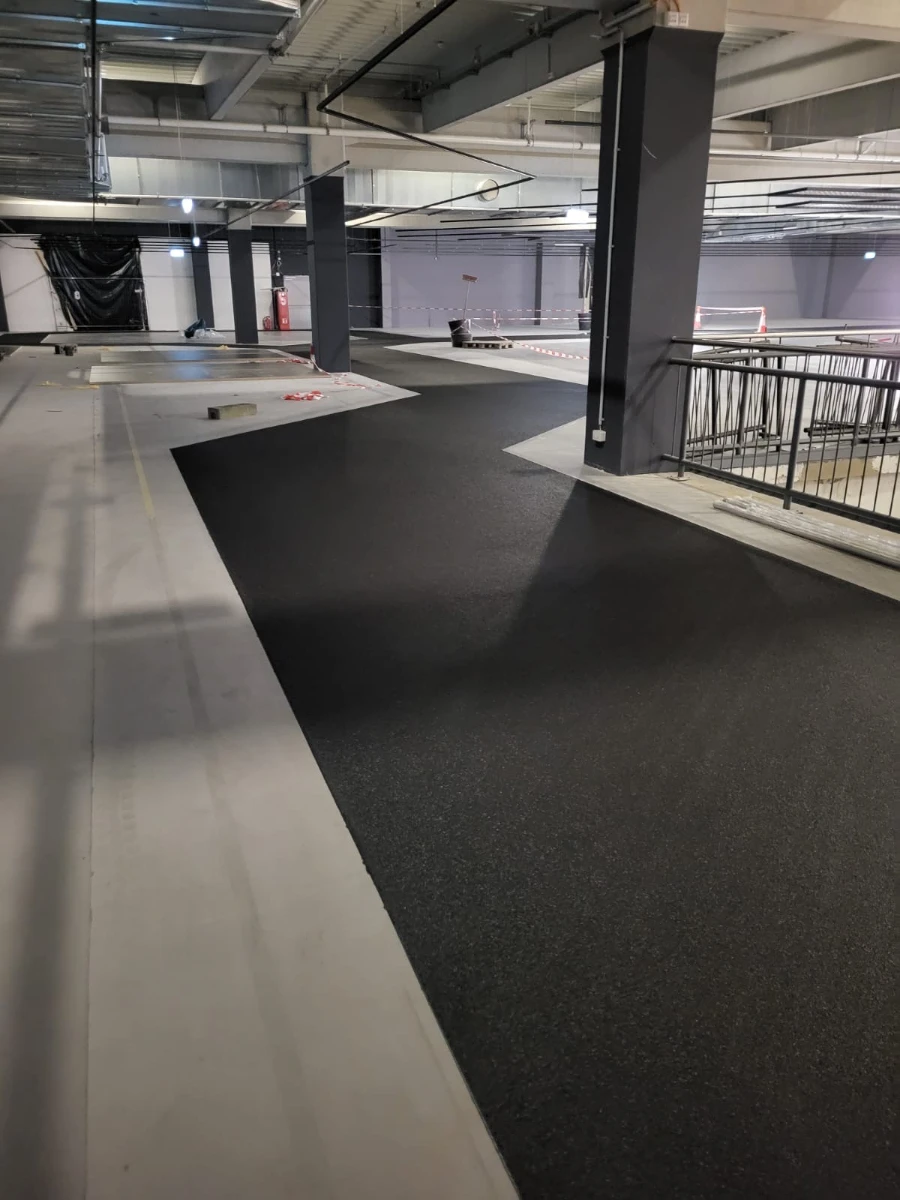
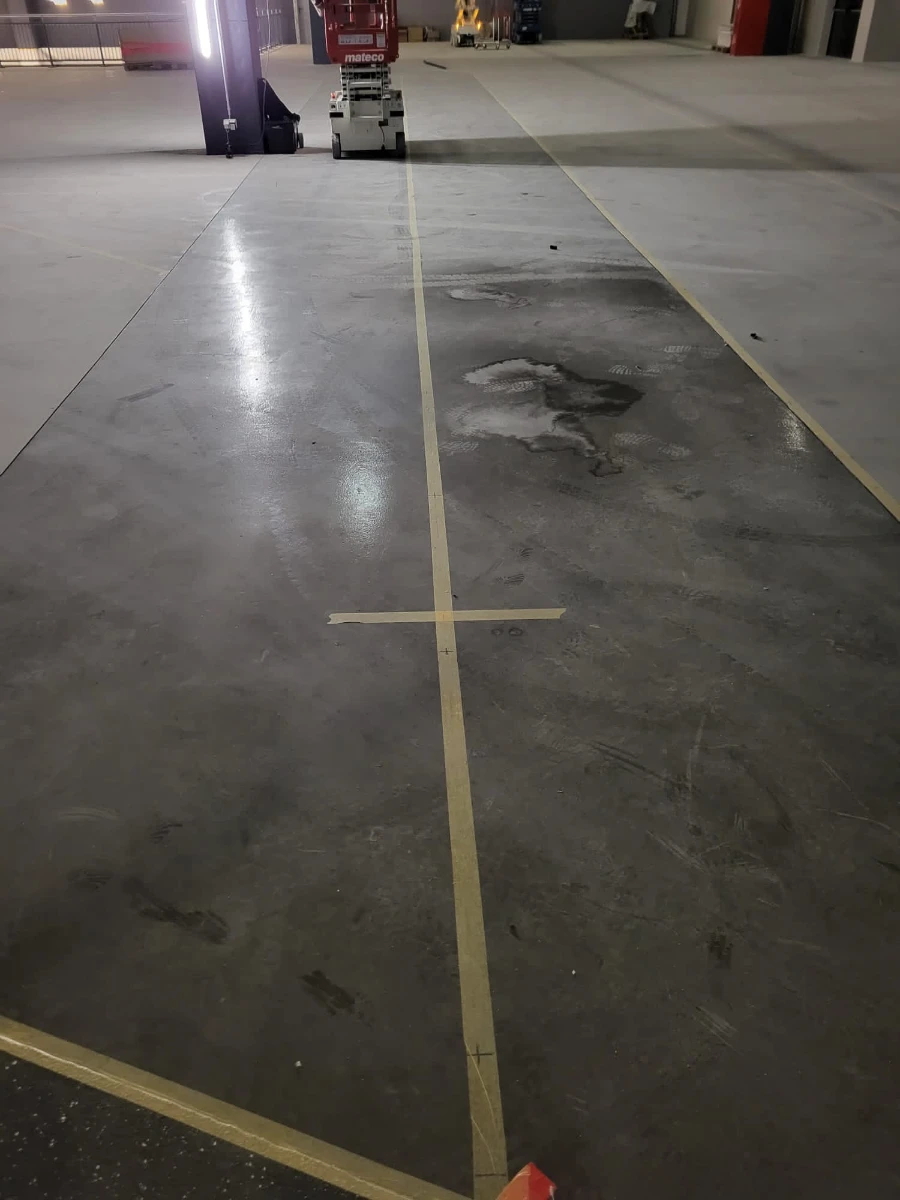
Abrasion & Rolling Load · Point Load · Tire Tracks · Stable Transitions · Predictable Reopening
Types and Varieties of Epoxy Resin Coatings
Electrostatic discharge (ESD) protection as an integrated system design
| Operating Principle | Conductive and non-conductive components are integrated into the system design, so that the derivative function remains stable during operation |
| Delimitation | ESD is not an “additional layer”, but rather system integration, including interfaces to standard areas |
| Typical Uses | Designated ESD zones, Assembly/Test Environments, clearly defined paths |
| Interpretation criterion | Industry-specific field | Decision relevance |
|---|---|---|
| Zone Boundaries | ESD ↔ Standard | Transitions are critical to functionality |
| Abrasion Profile | low to medium | Functional stability over time |
| Cleaning Process | defined | Maintain Consistent Surface Properties |
| Interfaces | Grounding/Discharge Path | Integration on a project-by-project basis |
| Surface structure | fine-tuned | Traction vs. Care |
| Section Approval | possible | Implement Zones in Order of Priority |
EP-type anti-wear system (quartz-filled/dispersed) for high shear and abrasive loads
| Operating Principle | The EP binder coat is sprinkled with mineral aggregate, Sealing adjusts the surface and closes the pores |
| Delimitation | Greater edge and shear strength, and generally a more durable surface in areas subject to heavy wear, Maintenance requirements increase with the degree of complexity |
| Typical Uses | Forklift Axles, Intersections, Gate/Ramp Area, Zones with changes in direction |
| Interpretation criterion | Industry-specific field | Decision relevance |
|---|---|---|
| System Thickness | 3,0-6,0 mm | Structural Load-Bearing Capacity and Wear Reserve |
| Textural Grade/Grain Size | fine to coarse (can be divided into zones) | Slip Resistance vs. Cleaning |
| Shear stress | high | Crucial at curves and intersections |
| Edge/Transition Protection | required | reduces breakouts at crossing points |
| Entry/Cleaning | dry to wet | Structure Selection Based on the Nursing Process |
| Phased Release | Foot/Transport/Heavy-Duty | Plan a phased start of operations |
EP thin-film coating (roller/squeegee system) for technically stable standard surfaces
| Typical Uses | Ancillary areas, Technical Fields, Storage areas with moderate traffic |
| Delimitation | Thinner than a gradient/blend, not suitable, to "smooth out" significant inventory irregularities |
| Operating Principle | A thin EP structure forms a continuous surface with limited layer reserve |
| Interpretation criterion | Industry-specific field | Decision relevance |
|---|---|---|
| Total thickness | 0,4-1,0 mm | The subgrade must be of high quality |
| Mechanical load | low to medium | Avoid wheel load and impact zones |
| Surface function | smooth to slightly textured | Focus on Ease of Cleaning |
| Substrate Preparation | high | Adhesion Is a Critical Issue with Thin Cross-Sections |
| Repair cost before | possible in certain cases | Stabilize hotspots in advance |
| Restricted Time Window | short to medium | Project Logic by Use |
EP-Novolac System (enhanced chemical resistance)
| Operating Principle | Novolac-based epoxy resin systems increase resistance to certain chemicals and cleaning agents (depending on the medium) |
| Delimitation | Selection is made based on the media list and exposure time, Mechanical design remains equally important |
| Typical Uses | Maintenance and Cleaning Zones, Areas with recurring contact with media |
| Interpretation criterion | Industry-specific field | Decision relevance |
|---|---|---|
| Media Profile | depends on the operation | Selection Makes Sense Only via the Media List |
| Exposure time | short to upright | Risk of infiltration |
| Surface finish | tight/sealed | Absence of Pores Is Relevant |
| Detailed Connections | critical | Minimize entry paths |
| Cleaning | Chemistry/Mechanics/Interval | affects long-term behavior |
| Zoning | Recommended | Set only critical zones to "high" |
EP Reaction Resin Mortar Coating (Edge and Hotspot Reinforcement)
| Operating Principle | EP mortar is used for reprofiling and rebuilding, around edges, Restoring the load-bearing capacity of spalls and localized high-stress areas |
| Delimitation | Primarily structural and edge repairs, not a "cosmetic" surface coating, is often combined with an EP wear layer |
| Typical Uses | Transitions, areas near joints, Areas with a predominance of point loads |
| Interpretation criterion | Industry-specific field | Decision relevance |
|---|---|---|
| Local installation height | 5-20 mm | Geometry for a Smooth Ride |
| Edge Profile | Radius/Bevel Defined | Impact Load Reduction at Joints |
| Resistance to Pressure and Impact | high | Suitable for point load clusters |
| Adhesion Strength Requirement | high | The subgrade must be stable |
| Combination | EP History/Spread | Wearing course on a stable base |
| Release Planning | zonal | Hotspots first, then the surrounding area |
EP self-leveling coating for uniform wear layers
| Operating Principle | A self-leveling EP system creates a continuous, uniform wearing course with a specified thickness |
| Delimitation | larger layer cross-section than thin-film systems, less structured than broadcast systems |
| Typical Uses | Production Areas, Assembly Areas, Cleaned zones with controlled traffic flow |
| Interpretation criterion | Industry-specific field | Decision relevance |
|---|---|---|
| Wear layer thickness | 2,0-4,0 mm | Wear Reserve and Stability |
| Surface image | smooth to finely textured | Cleanability vs. Basic Traction |
| Traffic Profile | Pallet Trucks to Forklifts | Evaluate Impact and Shear Loads |
| Ground state | load-bearing, low-crack, clean | Adhesion and Long-Term Stability |
| Detail Zones | Transitions, Peripheral Areas | Primary points of failure in operations |
| Approval Logic | in sections | Operating Hours and Detours |
Polyurethane cement (PU cement) for high thermal and chemical resistance
| Operating Principle | Cement-bonded PU systems offer high resistance to thermal cycling and certain chemical stresses (depending on the medium) while maintaining high mechanical load-bearing capacity |
| Delimitation | A different system character than traditional PU finishes, The surface is designed for its intended use and cleaning requirements |
| Typical Uses | Washing/Cleaning Zones, Process areas with temperature fluctuations, heavily used production areas |
| Interpretation criterion | Industry-specific field | Decision relevance |
|---|---|---|
| System Thickness | 6-12 mm | Robustness and Load Reserves |
| temperature change | relevant | Design Based on Process Reality |
| Media contact | depends on the operation | Consistency Only Through Media Profile |
| Mechanical load | high | Suitable for heavy use |
| Surface image | possible in a structured way | Traction in Wet Areas |
| Background/Details | critical | Create clean transitions |
Epoxy Resin Coating
An epoxy resin coating is used in industrial, logistics, and commercial areas as a wear-resistant topcoat when abrasion, shear forces from forklift traffic, and specific cleaning processes must be managed. In existing facilities , transitions, edge zones, and areas near joints are particularly critical because peak loads are transferred to the edges in these locations.
Quantec Industrieböden® GmbH implements epoxy resin systems to repair existing surfaces and structurally integrates specific zones, ensuring that the coating does not fail at typical weak points. In practice, the system variant is prioritized based on load profile, surface function, and downtime window.
Quantec Industrieböden® GmbH implements epoxy resin systems to repair existing surfaces and structurally integrates specific zones, ensuring that the coating does not fail at typical weak points. In practice, the system variant is prioritized based on load profile, surface function, and downtime window.

FAQ


Logistics & Warehousing (aisles, high-bay racking, material handling, gate/ramp)
Production & Mechanical Engineering (Machine Installation Areas, Traffic Routes, Built-in Components)
Food & Hygiene (Cleaning, Moisture, Sealing Paths, Detail Zones)
Cold Storage & Temperature Changes (Gradients, Condensation, Curing Window)
Chemicals/Media & WHG/AwSV (Sealing/Retention Function, Media Profile, Documentation/Acceptance)
ESD & Special Functional Areas (Conductivity, Functional Integrity, Repair Paths)
Request a Quote for Epoxy Resin Coating - Durable Solutions for Existing Structures
Please send us usage data, details of the damage, and a time frame. You will receive a structured assessment of the EP implementation and section planning.
The content of this page is intended to provide general information about Epoxy Resin Coating and does not constitute project-specific technical planning or a guarantee of specific properties. Since specific requirements and results depend on individual on-site conditions, no liability is assumed for the accuracy of this information.


INDUSTRIEBÖDEN ® GmbH

Your symptoms
The Quantec Solution
We will be happy to contact you.
Would you like a personal telephone consultation?